
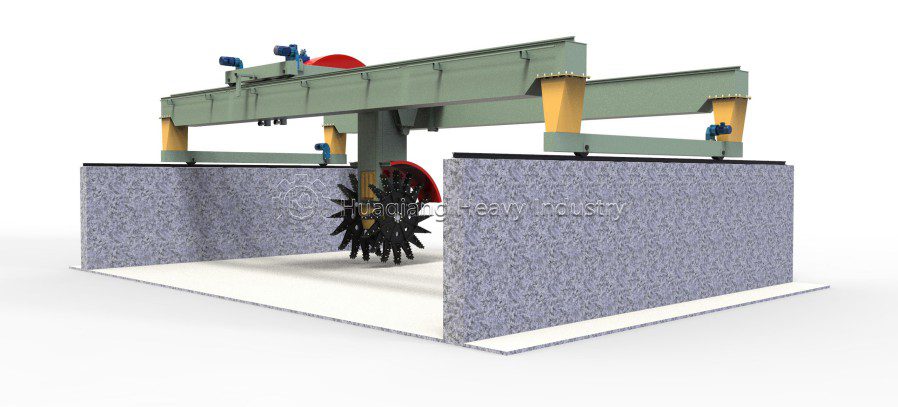
Large Wheel Compost Turner
The large-wheel compost turner is a high-efficiency turning machine specifically designed for wide-span, deep-trough fermentation systems. It utilizes mechanical turning wheels as its active components, with a central chain drive mechanism powering two large-diameter wheels to perform symmetrical turning operations. The equipment can be customized to match specific trough widths, making it suitable for fermentation facilities with spans ranging from a few meters up to thirty meters. Thanks to a unique energy-efficient drive mechanism, the machine can effectively handle deep material piles and wide spans while requiring relatively low power input.
System Composition and Technical Architecture
The technical architecture of the large-wheel compost turner can be categorized into the following layers:
(I) Mechanical Execution Layer: Comprising the rotating wheel and turning blades, this layer acts directly on the material. The tines on the wheel are made of high-strength, wear-resistant material, offering both durability and strong penetration capability. The diameter and number of wheels can be customized based on operational requirements.
(II) Power Transmission Layer: Consisting of a motor, a gearbox, and a chain drive mechanism. It utilizes an intermediate chain drive to rotate the wheel and achieves efficient power transmission through a specialized energy-saving drive mechanism.
(III) Travel and Positioning Layer: Comprising longitudinal and transverse travel components. It employs a variable-frequency drive (VFD) positioning carriage for precise movement and is equipped with either a wide, heavy-duty crawler chassis or a rail-based travel system.
(IV) Hydraulic Adjustment Layer: Consisting of a hydraulic lifting system that enables the automatic raising and lowering of the large turning wheel, ensuring the equipment can move freely regardless of the compost pile’s height.
(V) Intelligent Control Layer: Comprising a fully automated electrical control system, featuring functions for timed and constant-speed operation.

Industry Applications and Process Compatibility
The large-scale wheel-type compost turner is suitable for large-scale aerobic composting processes. In organic fertilizer production, the equipment can process organic waste such as livestock and poultry manure; in environmental protection, it can be used for the aerobic composting of municipal sludge; in agriculture, it handles agricultural waste such as crop straw; and in the industrial sector, it processes organic industrial waste such as sugar mill filter mud and distillery grains.
Material Suitability Analysis
The large-wheeled compost turner demonstrates strong adaptability to various materials. In terms of material types, it can process a wide range of organic wastes, such as livestock and poultry manure, sludge, straw, filter mud, and dregs. Regarding pile height, the turning depth ranges from 1.5 to 3 meters, enabling the processing of high piles. As for pile width, the turning width can be customized according to the fermentation channel, reaching up to 30 meters. Regarding material properties, the equipment transforms dense, viscous raw material piles into loose, resilient material.
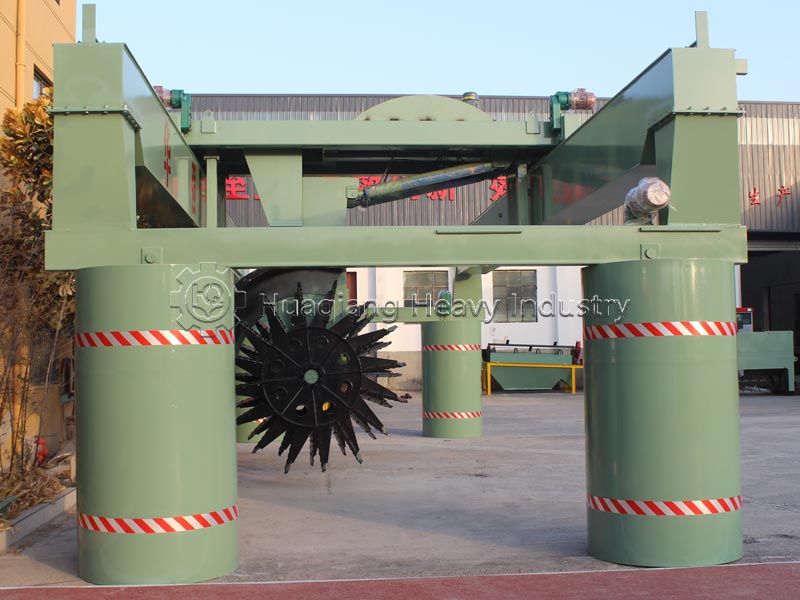
Core Principles and Operating Mechanisms
The core operating principle of the large wheeled compost turner relies on the synergistic effect of mechanical agitation and forced aeration. As the rotor spins at high speed, its tines penetrate deep into the material pile, accomplishing three key tasks during the turning process:
Mixing and Pulverizing: The tines on the rotor thoroughly break up and pulverize compacted material, effectively resolving issues with caking and clumping.
Oxygenation and Ventilation: The rotation of the rotor causes the material to tumble and scatter continuously, ensuring extensive contact with the air and rapidly replenishing oxygen levels within the fermentation pile.
Relocation and Turning: The equipment features directional movement capabilities; with each turning pass, the material is pushed forward at a steady speed. Through repeated passes, the material is gradually advanced from the feed end to the discharge end of the fermentation channel.
Factors to Consider in Equipment Selection
Selecting a large wheeled compost turner requires comprehensive consideration of the following factors:
Fermentation tank span: The equipment’s turning width must match the span of the fermentation tank. Large-scale wheeled compost turners can achieve a maximum turning width of 30 meters; the equipment can be custom-built to specific spans based on the tank width.
Pile depth: The equipment’s turning depth capacity should be selected based on the height of the material pile. Large-scale wheeled compost turners offer turning depths ranging from 1.5 to 3 meters.
Processing scale: Equipment specifications should be determined based on the project’s annual processing volume. Projects processing tens of thousands of tons require large-scale wheeled compost turners capable of handling high throughput.
Site conditions: The travel mechanism should be selected based on the ground conditions of the fermentation site—rail-mounted systems are suitable for fixed tank-style fermentation facilities, while crawler-type systems are suited for open-air fermentation sites.
Automation requirements: The level of control system automation should be selected based on the production management model.

Production Line Coordination and System Integration
Large wheel compost turners are at the core of the fermentation process in organic fertilizer production lines. The upstream section can be equipped with batching and mixing systems, while the downstream section can integrate equipment such as crushers, granulators, dryers, coolers, screening machines, and packaging units. The machine connects seamlessly with feeding and discharge systems, enabling fully automated operations from raw material intake into the fermentation tank through to the completion of the fermentation process. Depending on the production scale, the equipment can be configured for operation as a single unit or as a coordinated multi-unit system.
Models and Specifications of Large-Wheel Compost Turners
| Large Wheel Compost Turning Machine | ||||
| Model | Main Motor | Small Car Moving Motor | Big Car Moving Motor | Hydraulic Pump Motor |
| LP-10m | 55KW | 1.5KWX4 | 1.5KWX2(4) | 4KW |
| LP-12m | ||||
| LP-15m | ||||
| LP-20m | ||||