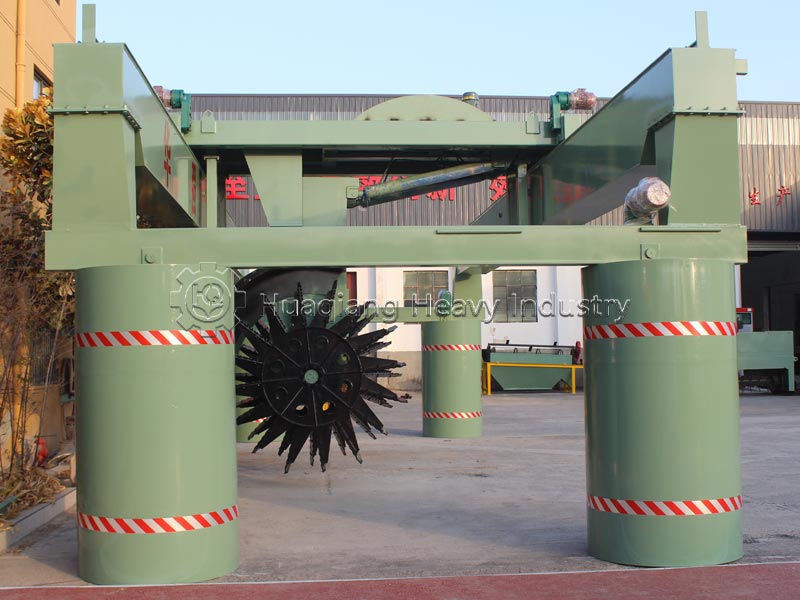
Requirements for Fermentation Tanks of Large Wheel Compost Turning Machines
Large wheel compost turning machine operate within fermentation tanks via tracks. The size, structure, ground conditions, and supporting facilities of the fermentation tank directly determine the equipment’s operation and fermentation results. Construction and use must strictly adhere to standards.
The tank’s length, width, and height must match the parameters of the compost production machine. Standard tank widths are designed based on the disc’s working span, with a mainstream range of 8–25 meters. A tank depth of 1.8–3 meters is recommended to meet the equipment’s deep turning requirements; too shallow a depth will prevent thorough material turning, while too deep a depth will result in insufficient turning. The length of a single tank should be based on capacity planning, generally no less than 30 meters, ensuring continuous feeding, fermentation, and discharging flow space. For multi-tank layouts, turning and maintenance access channels must be reserved.
Dedicated tracks must be laid on both sides of the tank. The track level error must be controlled within ±3mm. The track gauge must precisely match the equipment’s wheel set, and the installation must be secure and without looseness to prevent equipment deviation and swaying. The tank bottom is hardened with concrete, resulting in a smooth, wear-resistant surface with a slope controlled at 1‰–2‰. This facilitates leachate drainage and collection, preventing water accumulation that could lead to excessive material moisture and anaerobic fermentation.
The tank is a closed structure with a rain shelter to protect it from rain and snow affecting the material’s moisture content. The partition walls must be sturdy and load-bearing, with space reserved for future piping and ventilation. A drainage system is required, with drainage channels and a collection tank at the bottom to promptly drain any leaks.
Regular inspections are necessary during use to check for track deformation, tank cracks, and water accumulation. Debris should be removed promptly to ensure smooth equipment movement, a stable fermentation environment, and extended equipment and tank lifespan.