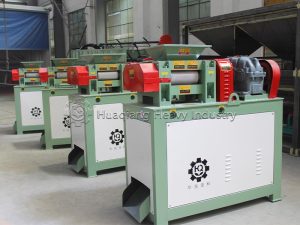
Moisture Requirements for Roller Press Granulator Production Lines
Fertilizer roller press granulators are a type of dry granulation process, relying on the material’s own binding force to press and shape the pellets. Moisture content is a key indicator determining pellet formation rate, pellet strength, non-sticking to rollers, and non-clogging of the die, and must be strictly controlled.
Different raw materials have different suitable moisture contents: Fermented organic fertilizers and bio-organic fertilizers are suitable for a moisture content of 12%–18%, with an optimal range of 14%–16%; compound fertilizers, blended fertilizers, and mixed fertilizers are suitable for a moisture content of 8%–15%, with an optimal range of 10%–12%. General-purpose powders can be judged by whether they can be formed into a ball when squeezed in the hand, crumble easily when lightly pinched, and not allow water to seep through the fingers; this is generally around 15%–20%.
If the moisture content is too high, exceeding 20%, the material is prone to sticking to the rollers, clogging the die, and pellets may stick together and deform, resulting in low finished product strength. It also increases the burden on subsequent drying and cooling processes. If the moisture content is too low, below 10%, the powder lacks binding properties, making it difficult to form a continuous material layer. After pressing, the powder is prone to loosening and pulverization, significantly reducing the pellet formation rate, increasing the amount of returned material, and decreasing production efficiency.
Moisture control must be implemented throughout the entire fertilizer roller press granulator production line: After fermentation, the material is first dried and dehydrated; in the mixing section, the moisture content must be uniform, with fluctuations not exceeding ±2%. If the material is too dry, a small amount of atomized water can be added; if it is too wet, dry material should be added for dilution and conditioning. During granulation, the material should be fed evenly, using a roller scraper to reduce roller sticking and die clogging.
After forming, the material undergoes crushing, screening, and cooling to ensure stable moisture content. The material is then returned to the machine for remixing. Strictly adhering to the above moisture range ensures high pellet formation, dense and smooth granules, and meets strength requirements, ensuring stable production line operation and reducing energy consumption and losses.