
Rotary Drum Granulation NPK Fertilizer Production Line: Process Principle and Debugging Method
Rotary drum granulation is the most commonly used granulation process in NPK fertilizer production lines. It boasts advantages such as simple operation, stable production capacity, and uniform particle size, and is widely used in small and medium-sized NPK fertilizer production enterprises. Its process principle and standardized operation directly determine the granulation qualification rate.
Process Principle: The rotary drum granulator is driven by a motor to rotate the drum (tilt angle 3-5°) at a uniform speed. Pre-treated nitrogen, phosphorus, and potassium raw material powders, along with a binder, are fed into the drum in a specific ratio. Utilizing the centrifugal force, friction, and gravity generated by the drum’s rotation, the raw material powders collide and adhere, gradually forming round and uniform particles (particle size 2-4mm). Simultaneously, hot air drying ensures the particles meet the required hardness standards.
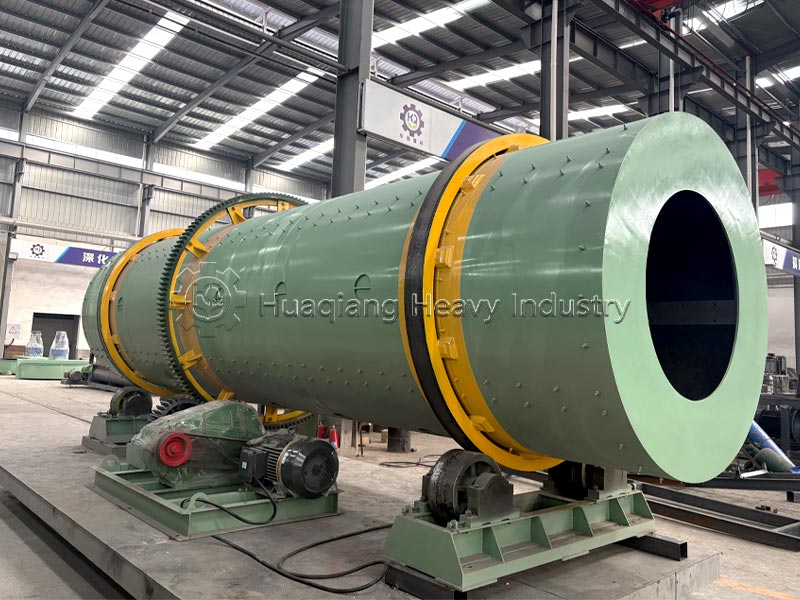
The standard operating procedure consists of four steps: First, start-up and debugging: check the drum speed and hot air temperature to ensure the drum is free of jamming and the temperature reaches 100-120℃. Second, feeding and mixing: simultaneously feed the pre-mixed raw material powder (accurately added according to the design formula) and binder (bentonite solution, 10% concentration) into the drum, controlling the feeding speed and binder dosage. Third, granulation and drying: the drum rotates at a uniform speed, and the raw material is granulated inside the drum while hot air is continuously supplied to dry the granules to a moisture content of ≤3%. Fourth, discharge and screening: the granulated material is screened by a vibrating screener; qualified granules are sent to the coating stage, while unqualified powder is returned to the crushing chamber for reprocessing.
Common debugging methods for drum granulators: If the granules are too small, increase the amount of binder and decrease the drum speed; if the granules are too large or clumped, reduce the feed rate and increase the hot air temperature; if the granules are not hard enough, extend the drying time and adjust the drum tilt angle. Standardized operation and timely debugging can ensure that the granulation qualification rate of the rotary drum granulation NPK fertilizer production line reaches over 95%.