
【FAQ】Why does the “particle size distribution” of granules determine whether they can command a high price?
While the pricing of fertilizer granules appears to be based on N-P-K content, there is actually a hidden metric at play: particle size distribution. For granular fertilizers with the same nominal size range (e.g., 2–4 mm), products with a narrow particle size distribution perform exceptionally well during blending, mechanical sowing, and storage, allowing them to sell for 10–15% more; conversely, products with a wide distribution face limitations at every stage and are relegated to the low-end market. Why is particle size distribution so critical? Different granulation technologies provide vastly different answers.
Granules produced by disc granulators naturally exhibit a wide particle size distribution. These machines rely on the rolling action of an inclined disc to agglomerate material into spheres; because materials remain in the disc for varying lengths of time and undergo nucleation at different moments, the output often contains a mix of fine powder (under 1 mm), compliant granules (2–4 mm), and oversized lumps (over 5 mm). Such equipment requires a screening and material-recycling system: oversized particles are returned to the granulator for re-rolling and shaping, while undersized fines serve as “seeds” for new granule formation. Although the agglomeration rate can reach 85–95%, the final product yield depends on screening efficiency and the recycling ratio. If corners are cut during screening, particle size distribution can spiral out of control, leading to segregation caused by excessive size disparity during the blending of bulk-blend (BB) fertilizers.
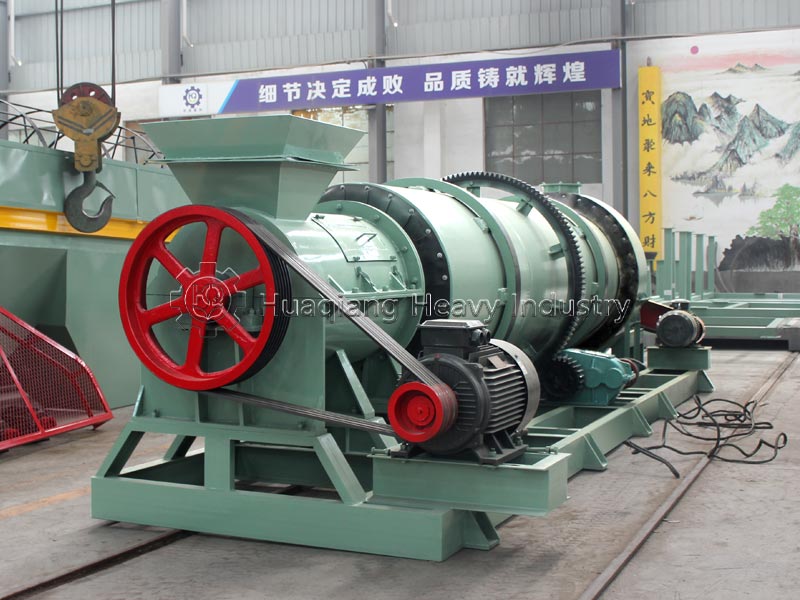
In roller press extrusion lines, particle size distribution is achieved through a process of crushing and screening. These lines utilize a dry, ambient-temperature process in which powdered material is first compressed into dense sheets, then cut by a crusher and graded by a screening machine. The particle size distribution is determined by both the gap between the crushing rollers and the screen mesh size, typically resulting in a more uniform distribution than that of disc granulation. However, the trade-off is that the granules are often irregularly shaped—flat flakes or cylinders—rather than spheres. The advantage of roller press extrusion lies in its precise control over particle size: the size range of the finished product can be adjusted simply by changing the gap between the crushing rollers. Furthermore, the process eliminates the need for drying, resulting in significantly lower energy consumption compared to wet granulation methods. This new two-in-one organic fertilizer granulator integrates mixing and granulation into a single unit, with particle size control built directly into the main machine. A front-end mixing system rapidly blends the materials, while a rear-end wet granulation system regulates particle growth rates by adjusting rotational speed and pan inclination. Materials form spheres layer by layer through a kneading action; this results in a narrower particle size distribution compared to traditional disc granulation and a consistent pelletization rate exceeding 90%. Highly compatible with high-moisture materials (25%–45% moisture content), the machine eliminates the need for intermediate conveying and separate mixing stages, making it ideal for small-to-medium production lines with limited space.
The ultimate significance of particle size distribution lies in the product’s intended application. For granules used in BB fertilizer (bulk blending), size variation must be kept within ±0.5 mm to prevent urea and potash from segregating within the packaging. For mechanical spreading, the 2–4 mm range is optimal; granules that are too small tend to clog nozzles, while those that are too large are prone to breakage. For long-distance transport, granules require a strength of at least 30 N to avoid excessive pulverization. Particle size distribution is not merely a figure on a specification sheet; it is a critical factor determining how far the product can be shipped and the price it can command.