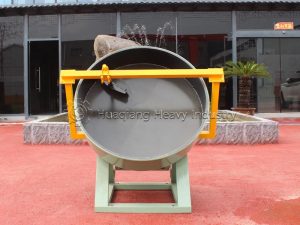
Typical Application Scenarios for Organic Fertilizer Disk Granulator Machines
Organic fertilizer disk granulator machines are suitable for the following scenarios:
- Large-scale production of traditional bio-organic fertilizer granulation
Suitable for fermented and composted livestock and poultry manure, straw compost, oilseed meal, and other raw materials, producing smooth, round granules with stable strength, ideal for large-scale granulation of base fertilizer for field crops.
- Organic-inorganic compound fertilizer granulation
Can mix organic fertilizer base materials with inorganic fertilizers containing nitrogen, phosphorus, and potassium, as well as trace elements. It has good adaptability to materials with different densities, meeting the needs for uniform granulation of compound fertilizers.
- Upgrading powdered organic fertilizers to granular form
Addressing the problems of dust generation and inconvenient storage and transportation of powdered fertilizers, the finished powder is returned to the disc granulator to produce granular fertilizer, improving marketability and ease of application.
- Small and medium-sized organic fertilizer plants/cooperatives
Low equipment investment, simple operation, and convenient maintenance, suitable for small and medium-sized production capacities, allowing for flexible switching of formulas and granule sizes.
- Bio-organic fertilizer/microbial fertilizer production
Low-temperature molding and gentle granulation avoid high-temperature damage to functional microbial agents, suitable for the gentle molding process of microbial-containing organic fertilizers.
- Waste resource utilization granulation
Processing kitchen waste compost, sludge organic fertilizer, and humic acid-based raw materials, achieving commercial granulation of solid waste resources through disc granulation.
- Recirculation and re-granulation
Equipped with a production line screening system, broken granules and powdered materials are returned to the disc granulator for re-granulation, reducing the return rate and improving the overall finished product yield.