
Three Philosophies of Pelletizing: Blending, Nurturing, and Pressing
In the world of fertilizer processing, every piece of equipment has its own quirks. Some excel at “blending”—combining readily available high-quality materials in a specific ratio; some are adept at “nurturing”—allowing the granules to slowly grow during rolling; and some believe in “pressing”—relying on brute force to clump the powder together. The NPK Blending Fertilizer Production Line, Disc Granulation Production Line, and Fertilizer Roller Press Machine perfectly represent these three distinct process philosophies, each playing an irreplaceable role in its respective application scenario.
The NPK Blending Fertilizer Production Line believes in the wisdom of “blending.” It doesn’t granulate, dry, or alter the chemical properties of any raw materials; it only does one thing—precisely weighing and mixing commercially available urea granules, diammonium phosphate, potassium chloride, and other finished fertilizers according to the formula. This production line’s strength lies in the precision of its ingredient formulation and the gentleness of its mixing: multi-compartment static scales accumulate weights in batches, minimizing error; a twin-shaft paddle mixer uses low-speed convection to allow different particles to repeatedly “shake hands” within the drum without damaging each other. The entire process is like an experienced bartender blending several ready-made base spirits in the right proportions—the spirits remain the same, but the proportions change, resulting in a completely different flavor. The advantage of this production line is its flexibility. Today it produces a 28-6-6 rice formula, tomorrow it switches to a universal 15-15-15 formula; only a few numbers need to be changed in the control system, without needing to clean the equipment or wait for the switch. For fertilizer blending stations serving thousands of acres of farmland and constantly needing to meet the “one formula per plot” requirement, this “on-demand” capability is invaluable.
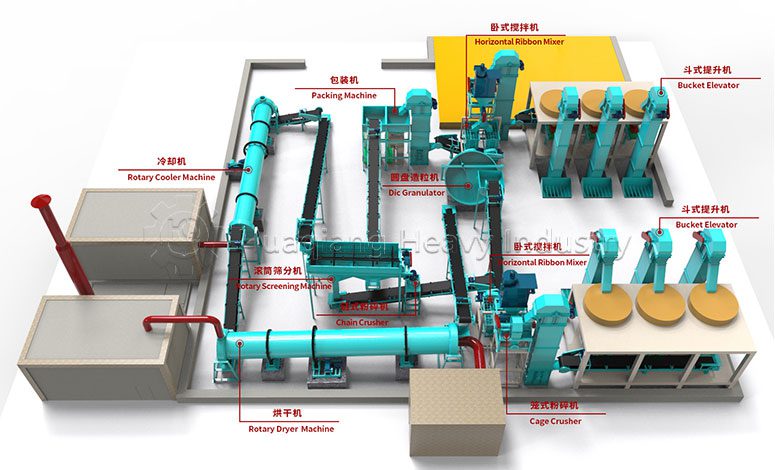
The disc granulation production line, on the other hand, takes a “nurturing” approach. Its main component is a large, tilting, rotating disc. After the material and a suitable amount of water or binder are added to the disc, they tumble and collide as the disc rotates, causing fine powder to adhere layer by layer like a snowball, gradually growing into round granules. This process requires patience—the disc’s tilt angle, rotation speed, and water volume all need to be carefully adjusted according to the material’s characteristics; it cannot be rushed or delayed. The resulting granules are round, smooth, and have an excellent appearance, making them particularly suitable for products like organic fertilizers or organic-inorganic compound fertilizers that require high-quality appearance. More importantly, this “wet pelletizing” method is highly adaptable to various materials, whether it’s highly fibrous, well-rotted organic matter or sticky sludge, each material can find its own pelletizing rhythm on the disc.
Unlike the previous two methods, the fertilizer roller press machine adheres to the principle of “compression.” It neither combines nor nurtures materials; instead, it solves the problem in the most direct way—two high-strength rollers rotate in opposite directions, instantly compressing the powder material into a cake under pressure of hundreds of megapascals, which is then crushed and sieved into granules. The entire process involves no water or heating; it relies solely on external force to compel powder particles to a distance where intermolecular forces can “join hands.” This “simple and direct” method is actually most advantageous in certain scenarios: when materials deliquesce upon contact with water or melt upon heating, wet granulation and high-tower spraying are ineffective, while roller extrusion can handle the situation effortlessly. Although the extruded particles are not as round as those produced by disc granulation, they have high density, high strength, and good slow-release properties, resulting in extremely low losses during storage, transportation, and machine sowing.