
Key Considerations for Equipment Selection in NPK Fertilizer Production Lines
When planning or upgrading an NPK fertilizer production line, the scientific and rational selection of equipment directly impacts product quality, operating costs, and long-term competitiveness. The primary consideration is production capacity – small lines produce 30–100 tons per day, suitable for regional markets; large lines can reach 800–1500 tons per day, requiring a comprehensive logistics and warehousing system. Secondly, the choice of granulation process is crucial: rotary drum granulation is highly adaptable and easy to maintain, suitable for various formulations; high-tower melt granulation produces products with good water solubility and a smooth appearance, but requires high investment and energy consumption; extrusion granulation requires no drying, saving energy and being environmentally friendly, but the granule strength is lower, making it suitable for specific markets.
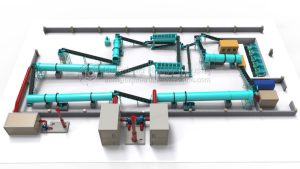
The accuracy of the NPK fertilizer production line‘s batching system is central to quality control. It is recommended to use loss-in-weight feeders with a PLC automatic control system, allowing for an error control within ±0.5%. Drying and cooling equipment should utilize high-efficiency, energy-saving rotary drum structures, and be equipped with waste heat recovery devices to reduce fuel consumption. For environmental protection, a multi-stage dust removal system (such as cyclone + bag filter combination) must be configured to ensure dust emissions are below national limits (usually ≤30 mg/m³).
Furthermore, equipment materials must be corrosion-resistant and wear-resistant, especially components in contact with potassium chloride or ammonium sulfate, which should be made of stainless steel or have special coatings. The control system should support formula storage, fault alarms, and remote monitoring functions to facilitate intelligent management. Finally, the technical service capabilities and spare parts supply cycle of the NPK fertilizer equipment supplier must also be considered. A comprehensive assessment of process compatibility, energy efficiency, environmental compliance, and total life cycle cost is necessary to select the most suitable equipment solution for the company’s development, laying the foundation for efficient, stable, and environmentally friendly production.