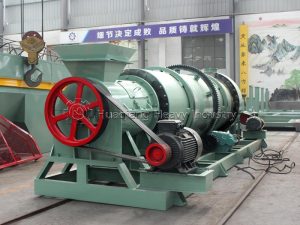
How to Prevent Moisture Absorption and Agglomeration During Production of a Organic Fertilizer New Type Two in One Granulator
To ensure stable output and prevent moisture absorption and agglomeration in a new type two in one organic fertilizer granulator, the key lies in temperature control, humidity control, speed control, and airtight protection.
Before production, the raw materials should be pre-treated by crushing and sieving fermented organic fertilizer and auxiliary materials to control the moisture content at 20%–30%. Excessive moisture leads to agglomeration, while excessive dryness prevents granulation. The raw material storage area should be kept dry and well-ventilated, avoiding rain and moisture to reduce the risk of agglomeration from the source.
During granulation, the spindle speed, feeding speed, and die gap should be properly adjusted to ensure moderate granule density, small internal voids, and low moisture absorption. The discharge temperature should be controlled between 40℃ and 55℃. Excessive temperature leads to moisture reabsorption, while insufficient temperature results in insufficient granule strength. Low-temperature drying and air-cooled conveying can be added to quickly reduce granule moisture content and improve strength.
The entire bio-organic fertilizer production line uses sealed feeding, sealed conveying, and sealed screening to reduce granule contact with humid air. The workshop is well-ventilated; doors and windows are closed on rainy days, and dehumidifiers are used when necessary to prevent excessive humidity and secondary moisture absorption.
After discharge, the material is promptly rounded, sieved, and cooled before quickly entering the packaging stage, minimizing outdoor storage time. Moisture-proof inner film bags are used for packaging, with tight seals, and the material is elevated during stacking to prevent moisture buildup and clumping during storage.
Through raw material humidity control, granulation temperature control, full-process sealing, and rapid cooling packaging, the problems of moisture absorption, wall adhesion, and clumping in the production of the new organic fertilizer two-in-one granulator are effectively avoided, ensuring that the granules are round, uniform, high-strength, and do not pulverize, thus improving the quality of the finished product and its market competitiveness.