
Comparison of Granulation Methods: Roller Press Extrusion vs. Novel Organic Fertilizer Granulators
Organic fertilizer granulation technology is constantly evolving. Besides traditional wet granulation, dry extrusion granulation is gaining favor in specific fields due to its unique advantages. Simultaneously, several wet granulation devices, referred to as “novel organic fertilizer granulators” (such as stirring-tooth granulators and double-die granulators), are emerging, often claiming breakthroughs in raw material adaptability and granulation efficiency. This article will focus on comparing roller press extrusion granulators (representing dry granulation) with a typical novel organic fertilizer granulator (stirring-tooth granulator, representing a new force in wet granulation), analyzing their characteristics and differences in practical applications.
- Roller Press Extrusion Granulator Working Principle: This method utilizes a pair of counter-rotating pressure rollers with specific shaped indentations (such as spherical, pillow-shaped, or strip-shaped) on their surfaces. Dry powdered material is compressed and shaped under strong mechanical pressure without the need for liquid binders, making it a dry granulation method.
- Novel Organic Fertilizer Granulator (taking the stirring-tooth granulator as an example) Working Principle: These devices mostly employ wet granulation. In the case of a stirring-tooth granulator, high-speed rotating stirring teeth or similar mechanisms are used to powerfully mix, shear, agglomerate, and round the wet powdered organic material. The resulting aerodynamic forces then facilitate granulation, spheroidization, and densification within the machine.
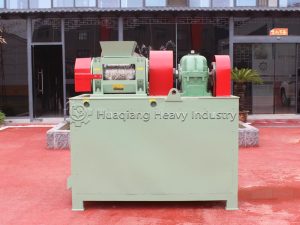
Granulation Principle and Moisture Requirements: Roller press extrusion is a dry forced molding process requiring dry raw materials; the novel stirring-tooth method is a wet mixing and granulation process with specific moisture requirements, and the finished product needs drying.
Finished Product Physical Characteristics: Roller press extruded granules have high density, high hardness, and controllable shape; novel stirring-tooth granules are mostly spherical, and their density and hardness are usually lower than extruded granules.
Process Flow and Energy Consumption: Roller press extrusion has a shorter process, eliminating the need for drying, resulting in relatively lower energy consumption in the granulation stage; novel stirring-tooth (wet method) usually requires drying, so the overall energy consumption needs to be comprehensively evaluated. Roller Compaction Granulator: Its advantages include dry granulation, no drying required, high particle density, and controllable particle shape. It is suitable for specific dry powder raw materials and scenarios where particle hardness is important.
New Type Organic Fertilizer Granulator (Agitating Teeth): Its advantages include high wet granulation rate and good spherical particle shape. Some models claim broad adaptability to raw materials and simplified pre-treatment, but usually require drying.
Market and Applications: Roller compaction technology is mature and widely used; new granulators are attracting significant market attention, but their long-term stability and actual operating efficiency need to be considered.
If your raw material source is primarily dry powder, or you want to avoid the drying process to reduce energy consumption and investment, and have specific requirements for particle hardness and shape, the roller compaction granulator is a priority option. Conversely, if you handle a wide variety of raw materials, want to achieve a high granulation rate and good spherical particles, are willing to invest in drying equipment, and value the potential simplification of raw material pre-treatment offered by new equipment, then you can consider and evaluate suitable new organic fertilizer granulators. When choosing new equipment, it is essential to conduct thorough material testing and evaluate the supplier’s technical capabilities.