
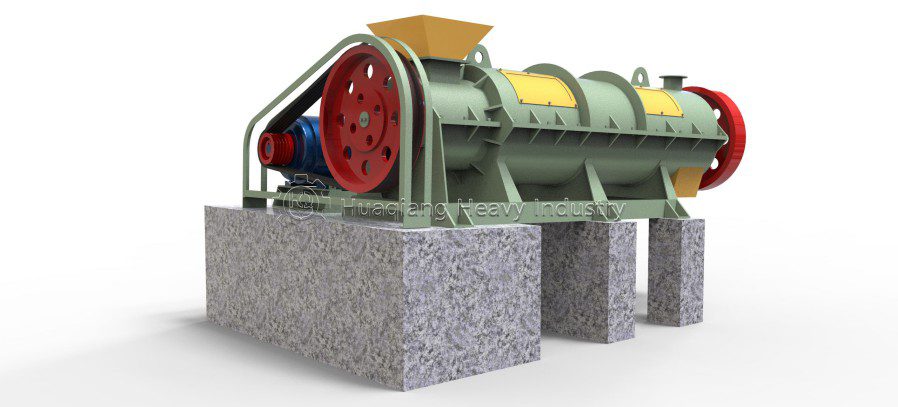
New Type Organic Fertilizer Granulator
This new type of organic fertilizer granulator is a high-tech product developed by agricultural machinery research institutes and related enterprises, drawing upon years of experience in the design and manufacture of compound fertilizer processing equipment. Utilizing a continuous wet-process ram-extrusion granulation design, the machine is primarily used to granulate various types of fermented organic materials.
The machine produces spherical granules with an organic matter content of up to 100%, enabling the production of purely organic granules. It leverages the characteristic ability of organic particles to interlock and grow under applied force, eliminating the need for binders during granulation. The resulting granules are solid and can be screened immediately after formation, thereby reducing energy consumption during the drying process. Typically, the finished granules range from 0.3 to 5 mm in diameter, with a granulation rate of ≥90%. Granule size can be adjusted by varying the material feed rate and the rotational speed of the main shaft.
The machine body is constructed from Q235 carbon steel, while the forming components are made of wear-resistant alloy steel; the unit features an all-welded structure with key components undergoing quenching treatment. It offers a high granulation rate, producing uniform, strong, and durable granules that resist breakage. The machine is robust, features long-lasting wear-resistant parts, operates stably with a low failure rate, and accommodates a wide range of raw materials to meet varying production requirements.
Structural Composition
The new organic fertilizer granulator primarily consists of the following components:
1. Machine Body: The main structural component, manufactured from high-quality carbon steel or thickened seamless steel pipe. It houses the granulation chamber—the workspace where the granulation process takes place. The body features a robust, durable design that is resistant to deformation.
2. Granulation Rotor: The core working component, featuring specially designed stirring teeth. These teeth are made of wear-resistant alloy and facilitate the vigorous mixing and propulsion of materials through high-speed rotation. The layout of the teeth is optimized to ensure high granulation efficiency and product quality.
3. Drive System: Comprising the motor, gearbox, and transmission assembly. The equipment features a variable speed function, allowing users to flexibly adjust the main shaft speed based on material characteristics and production requirements.
4. Frame and Base: A sturdy frame welded from thickened channel steel. All components are mounted on this unified frame, ensuring structural integrity, smooth operation, and ease of installation.
Key Performance Characteristics
High Granulation Rate: The rate of qualified granules reaches 80%–90% or higher; granules are uniform in size, with an oversized-particle rate of less than 15%. The granules are spherical, with a sphericity of ≥0.7.
High Granule Strength: The organic fertilizer granules exhibit higher compressive strength than those produced by traditional disc or rotary drum granulators. They are solid and resistant to breakage, making storage, transport, and application convenient.
Strong Raw Material Adaptability: Particularly suitable for granulating lightweight, fine-powder materials. It can process livestock and poultry manure (chicken, pig, cattle), high-fiber materials (crop straw, distillery grains, spent mushroom substrate, medicinal residue), as well as humic acid and municipal sludge. It accommodates a wide range of formulations.
Energy-Efficient and Eco-Friendly: Fermented organic matter can be granulated directly without drying. No binders are required during granulation. Eliminating the drying step significantly reduces manufacturing costs. The equipment features low energy consumption and noise levels, with no waste emissions during the granulation process.
Ease of Operation: Simple to operate, stable in performance, and low in failure rate. Granule size uniformity can be adjusted via a variable-speed control function to meet user requirements. Operations can be handled by just 1–2 people.
Durable and Long-Lasting: The main body is constructed from high-quality carbon steel or stainless steel, featuring a corrosion-resistant and wear-resistant design. Forming components are made of wear-resistant alloy steel, integrally welded, and key parts undergo quenching treatment. Wear-resistant components offer a long service life.
Suitable raw materials
The new organic fertilizer granulator is suitable for granulating a wide range of organic raw materials:
Livestock and poultry manure: chicken, pig, cattle, and sheep manure, etc.
Crop residues: straw, rice husks, cotton stalks, weeds, etc.
Industrial organic waste: distillery grains, spent mushroom substrate, herbal residue, sugar mill filter mud, papermaking sludge, etc.
Urban organic waste: municipal sludge, kitchen waste, etc.
Others: peat, lignite, humic acid, oil-cake fertilizer, etc.
The finer the particles of the raw material powder, the higher the sphericity of the granules and the better the granulation quality; ideally, the material particle size should be finer than 200 mesh prior to granulation. The equipment accommodates a wide range of raw material moisture content, typically between 20% and 40%.
Target Audience and Selection Recommendations
The primary target groups for the new type of organic fertilizer granulator include the following:
1. Large-scale livestock and poultry farms: Livestock farming generates significant amounts of manure, which represents both an environmental burden and a valuable resource. Introducing an organic fertilizer granulator allows manure to be converted into granular organic fertilizer, establishing a “breeding–manure–granulation–crop cultivation” circular model. Small-to-medium models (such as the YSL40 or YSL60) are recommended, with a daily processing capacity sufficient to meet the farm’s own waste treatment needs.
2. Organic fertilizer manufacturers: Established organic fertilizer plants need to upgrade from basic production capabilities to mass production. It is recommended to select a model based on target production capacity while allowing for a 10%–20% capacity margin. Priority should be given to models that offer stable granulation, energy efficiency, durability, and environmental compliance, with a focus on granulation rates and granule quality.
3. Agricultural cooperatives and family farms: These entities have small-scale organic fertilizer processing needs and limited investment budgets. Compact, space-saving, and easy-to-operate small models are suitable choices; they can be operated by just one or two people and handle a daily throughput of 1–5 tons of organic raw materials.
4. Bio-organic and compound fertilizer manufacturers: These producers require the ability to manufacture high-quality, spherical organic fertilizer granules. Models offering high granulation precision and excellent granule uniformity are recommended, with particular attention paid to the adjustable range of die apertures to enhance equipment versatility.

Models and Specifications of New Organic Fertilizer Granulators
| New Type Organic Fertilizer Granulator Machine | ||||
| Model | Capacity (t/h) | Output Granules Size (mm) | Motor Power (Kw) | Outside Dimension (mm) |
| YSL-60 | 1-2 | 1-5 | 37 | 3700*1800*1050 |
| YSL-80 | 2-4 | 1-5 | 45 | 3700*2100*1300 |
| YSL-100 | 3-5 | 1-5 | 55 | 3750*2500*1500 |
| YSL-120 | 4-7 | 1-5 | 75 | 4900*2950*1900 |
| YSL-150 | 5-8 | 1-5 | 90 | 5000*3300*2150 |