
【FAQ】Why can’t a disc granulator for bio-organic fertilizer be used for ordinary organic fertilizer?
At first glance, disc granulators look alike—featuring a tilted disc, a rotating drive mechanism, and a water-spraying system. However, the design logic behind granulators for bio-organic fertilizer and those for ordinary organic fertilizer differs significantly. Attempting to use the same machine for both often results in the death of microbial strains, failure to form proper granules, or suboptimal performance in both areas.
Disc granulators for ordinary organic fertilizer: Prioritizing granulation rate and output. These machines process fermented, decomposed organic materials that do not contain functional microorganisms. The design focuses on maximizing the granulation rate, stabilizing particle size distribution, and minimizing the proportion of material that must be recycled (fines/oversize). The disc tilt is typically adjustable between 35° and 55°, with a rotation speed of 11–20 rpm; materials roll into granules on the disc surface using their own moisture content, achieving granulation rates of 85%–95%. Temperature constraints during the subsequent drying stage are relatively loose, provided the material does not scorch.
Disc granulators for bio-organic fertilizer: Temperature is the critical limit. These machines process materials containing functional microorganisms. Microbes such as *Bacillus subtilis* and phosphorus- or potassium-solubilizing bacteria are extremely sensitive to temperature; survival rates plummet above 60°C, and most strains die at 70°C. Consequently, these granulators must feature low-friction disc coatings to minimize heat generated by friction between the material and the disc. Rotation speeds are typically controlled at 15–25 rpm to maintain a stable temperature of 30–55°C throughout the granulation process. Furthermore, conventional high-temperature drying cannot be used; instead, a low-temperature, high-airflow drying method is required, with an inlet air temperature of 60–80°C and a discharge temperature not exceeding 45°C. If a standard disc granulator designed for ordinary organic fertilizer is used to produce bio-organic fertilizer, the high-friction disc surface and high rotational speed will cause the material temperature to rapidly exceed 60°C. Combined with the subsequent high-temperature drying process, any beneficial microbial strains preserved during the initial fermentation and ingredient mixing stages would be completely destroyed.
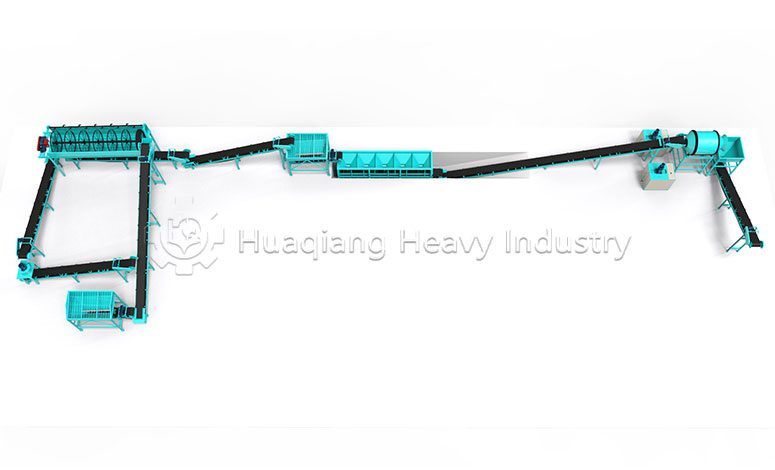
NPK Blending Production Line: Disc granulation is entirely unnecessary here. NPK blending lines follow a different approach. They process finished granules—such as urea, ammonium phosphate, and potassium chloride—meaning the raw materials are already in granular form. The line performs only physical mixing; there is no granulation, water addition, or heating involved. Installing a disc granulator on a blending line would not only be a waste of investment but would also compromise granule integrity due to the addition of water, leading to the formation of fines and increased segregation.
Roller Press Granulation Production Line: The route for dry powders. Roller press lines process dry powders with a moisture content of 8%–15%, compressing the material into dense sheets under high pressure before crushing and screening them into granules. The process requires neither water addition nor drying, making it suitable for inorganic fertilizers or standard organic fertilizers that do not contain live microbes. However, the high-pressure compression generates frictional heat—potentially raising roller surface temperatures above 70°C—which makes it unsuitable for bio-organic fertilizers as well.
The distinctions between these three routes are clear: use blending for pre-existing granules, disc granulation for wet materials, and roller press granulation for dry powders. Wet materials containing live microbes require low-temperature disc granulation and strictly temperature-controlled drying. Choosing the wrong equipment leads to costs far exceeding any initial savings, resulting from microbial die-off, plummeting granulation yields, and doubled energy consumption.