
【FAQ】Why do some fertilizer production lines generate almost no recycle material, while others rely on it to function?
The design of the recycle system in a fertilizer production line is often glossed over as merely an “auxiliary system.” However, the recycle ratio directly reflects the line’s process logic, energy consumption, and raw material adaptability. Three typical production lines—NPK blending, bio-organic fertilizer disc granulation, and roller press granulation—approach recycle material in vastly different ways.
NPK Blending Fertilizer Production Line: A “Zero-Recycle” Logic. The NPK blending process is purely physical; it involves no granulation, water addition, or heating. Raw materials such as urea, ammonium phosphate, and potassium chloride are already suitable industrial granules, so the mixture is packaged directly. Since there is no stage where “substandard granules require reworking,” there is virtually no process-generated recycle material. The challenge here lies not in recycling, but in segregation—differences in particle size and specific gravity among raw materials can cause layering after mixing. Segregation is prevented through source control: keeping raw material particle size variations within ±0.5 mm and minimizing drop heights during conveying. A zero-recycle approach means a shorter process flow and lower energy consumption, provided the raw materials meet specifications.
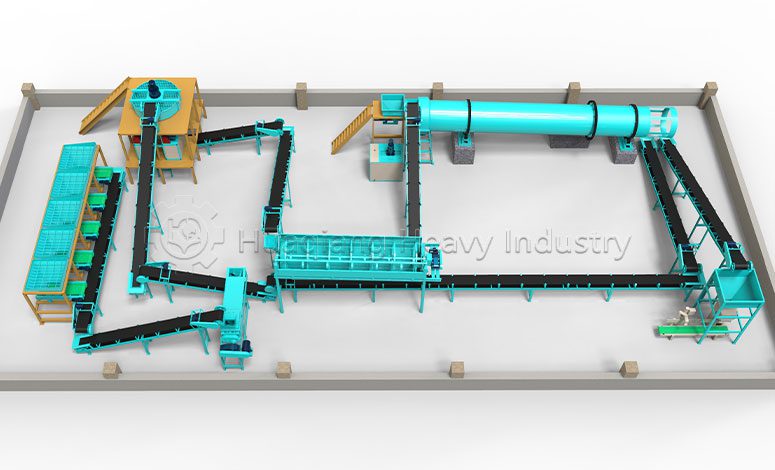
Bio-organic Fertilizer Disc Granulator: Low Recycle Rate, with Recycle Material Acting as “Seed Crystals.” The bio-organic fertilizer disc granulator employs a wet agglomeration process where materials roll into spheres on an inclined disc; the granulation rate typically reaches 85%–95%. However, 5%–15% of the material—consisting of fine powder and oversized clumps—must be screened out and recycled. This recycled material is not waste; the fine powder returned to the granulator acts as “seed crystals,” promoting the nucleation and growth of new granules. While the recycle ratio is relatively low, the design of the recycle system directly impacts granulation stability. Key control points include material moisture content (25%–35%) and granulation temperature (not exceeding 55°C)—the latter being particularly critical for bio-organic fertilizers containing functional bacteria.
Roller press granulation production lines are characterized by high material recirculation rates and a standard closed-loop system. These lines utilize a dry, high-pressure forming process in which powdered material is first compressed into dense flakes, then cut by a crusher and classified by a screening machine. The crushing process inevitably generates a significant amount of fine powder, resulting in a recirculation rate typically ranging from 30% to 50%. A closed-loop recirculation system is standard: oversized particles retained on the screen and undersized fines passing through it are conveyed back to the mixer or roller press for reprocessing. An excessively high recirculation rate indicates issues such as roller surface wear, screen damage, or improper crusher settings, requiring immediate troubleshooting. The actual production capacity of the entire line is ultimately determined by the interplay between the recirculation system’s conveying capacity and the mixer’s intake capacity.
The differences in recirculation across these three types of production lines stem fundamentally from their respective forming methods: simple blending without granulation results in zero recirculation; pan granulation relies on rolling to form spheres, yielding low recirculation where the fines can serve as seed particles; and roller press granulation relies on high-pressure crushing, resulting in high recirculation that necessitates a closed-loop system. When selecting equipment, inquiring about the recirculation rate, the destination of the recirculated material, and the system’s processing capacity provides a better indication of long-term operational stability than simply looking at the main unit’s power rating.