
【FAQ】Why is it difficult to balance granule strength and microbial activity?
There is a rarely discussed contradiction in fertilizer production: granule strength and microbial activity often come at the expense of one another. High-strength granules withstand transport and minimize dust formation, but achieving such strength usually requires high-pressure extrusion or high-temperature drying, both of which kill beneficial microbes. Conversely, bio-organic fertilizers with high microbial activity require gentle, low-temperature forming processes; however, the resulting granules often lack strength and are prone to breakage during packaging and transport. Understanding this trade-off is essential to grasping the design logic behind different production lines.
NPK blending lines bypass this specific contradiction but face a different challenge. These lines utilize purely physical mixing—without granulation or heating—thereby preserving the original form of the granules. Consequently, there is no need to choose between strength and activity, as ingredients like urea, ammonium phosphate, and potassium chloride are inherently high-strength industrial granules. Instead, the primary challenge is segregation: differences in particle size and specific gravity among the raw materials can cause them to separate spontaneously during conveying and packaging. This issue is addressed through the use of twin-shaft paddle mixers and by ensuring—at the source—that the particle sizes of the various raw materials are well-matched. The core of the entire production line lies not in granulation, but in precise proportioning and uniform mixing.
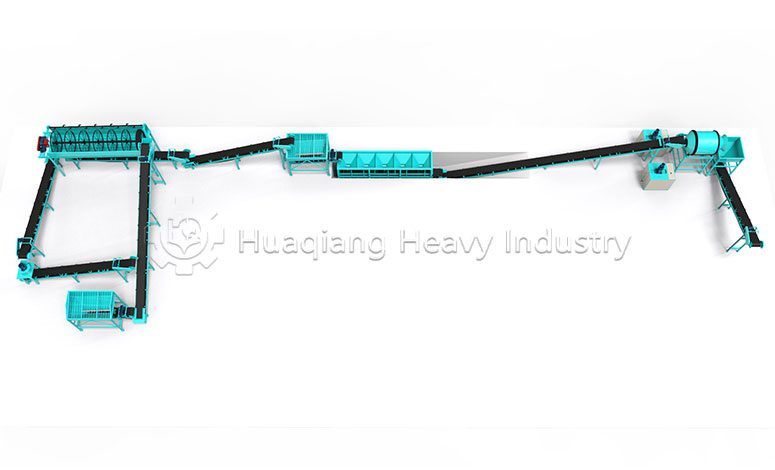
Double-roller extrusion granulation prioritizes high strength, but the cost is high heat. Materials are compressed under high pressure, yielding granule strengths exceeding 30 N—ideal for long-distance transport. However, friction between the material and the roller surfaces generates heat, potentially raising roller temperatures above 70°C. While this poses no problem for conventional chemical fertilizers, it is detrimental to bio-organic fertilizers containing beneficial microbes, as such temperatures cause massive microbial die-off. Therefore, double-roller extrusion technology is better suited for inorganic fertilizers or organic fertilizers where microbial activity is not a requirement; it is unsuitable for granulating bio-organic fertilizers.
Disc granulation for bio-organic fertilizers prioritizes microbial activity. The disc granulator for bio-organic fertilizer employs a room-temperature physical forming process; materials naturally roll into spheres on an inclined disc surface, maintaining a stable temperature range of 30–55°C throughout, which ensures a functional microbial survival rate exceeding 80%. However, the granule strength achieved via disc granulation is typically lower than that of extrusion granulation, generally ranging from 10 to 15 N. While this strength is sufficient for on-site application or short-distance transport, long-distance transport requires enhanced protective measures during packaging and shipping, or the adoption of a post-inoculation strategy—granulating, drying, and cooling the product first, then spraying the microbial solution onto the granule surfaces. This approach preserves granule strength while preventing the loss of microorganisms during the granulation and drying stages.
The logic for choosing between these two approaches is clear: product positioning dictates the process route. Fast-acting chemical fertilizers require high strength and transport durability, making roller extrusion or tower granulation the preferred choices; conversely, bio-organic fertilizers require microbial activity and soil-improving properties, making the low-temperature disc granulation process the ideal solution. Attempting to achieve both high strength and high microbial activity on a single production line often results in suboptimal performance in both areas. Equipment can be combined, but process parameters must be controlled independently—this is the practical logic behind fertilizer production line design.