
【FAQ】How to Preserve Microbial Activity in Bio-Disk Granulation?
Bio-organic fertilizer disc granulators utilize a low-temperature granulation process, increasing microbial survival rates to over 80%, significantly superior to traditional high-temperature granulation equipment (survival rates of only 30%~50%). This is because disc granulation is a physical granulation process—microorganisms are directly added to powdered organic matter; the entire process is physical, and the activity of the microorganisms is not destroyed after granulation.
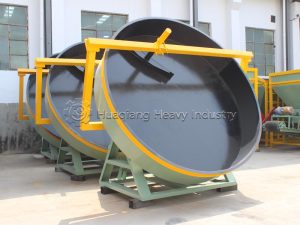
Key Process Control Points: When using disc granulation for bio-organic fertilizer, different production processes greatly affect the survival rate of specific microorganisms. Studies have shown that to achieve the technical target of 0.1~0.2 billion viable specific microorganisms per gram of finished fertilizer, a process of mixing microorganisms with organic and inorganic materials for granulation followed by drying is not recommended. Instead, a drying-free production process or separate granulation is preferable. During disc granulation, the disc inclination angle is generally controlled between 40° and 55°, the rotation speed is 11 to 20 r/min, and the temperature throughout the process is ≤55℃ to ensure that the functional bacteria are not inactivated by heat.
Inoculant addition method: For bio-organic fertilizers that require the addition of functional microbial agents, they can be added simultaneously during the granulation stage. The microbial agent is mixed with microbial residue at a 1:5 ratio to expand the volume, and then added to the material. It is recommended to use brown sugar water or starch solution instead of chemical binders, as this provides a carbon source and avoids the inhibition of microorganisms by chemicals. Shelf-life tests show that functional bacteria (such as Trichoderma and Bacillus) in granular fertilizers have a stronger survival rate than those in powdered fertilizers. The granular form provides a more stable microenvironment for microorganisms, maintaining a viable count even after 60 days of storage.
Production line matching recommendations: High-temperature drying should be avoided after disc granulation of bio-organic fertilizers; low-temperature air drying or natural air drying methods are preferable. If drying is necessary, the inlet air temperature should be controlled within 60℃ to 80℃. The entire bio disk organic fertilizer machine production line should be designed around the principle of “low-temperature granulation and room-temperature molding” to ensure that the activity of functional bacteria is preserved to the maximum extent.