
【FAQ】Can a single production line be shared by bulk-blended fertilizers and bio-organic fertilizers?
At first glance, NPK bulk-blending fertilizer lines and bio-organic fertilizer disc granulation lines share many similarities—both involve batching, mixing, conveying, and packaging stages. Consequently, many investors wonder if a single line could produce both types of products to reduce investment costs and improve equipment utilization. The answer is no. The two lines have fundamental conflicts regarding raw material characteristics, processing temperatures, and cleanliness requirements; attempting to force a shared line would result in poor performance for both products.
Conflict 1: “Cross-contamination” from raw material dust. During NPK bulk-blending production, the conveying and mixing of granules—such as urea, ammonium phosphate, and potassium chloride—generate chemical fertilizer dust. This dust is hygroscopic and corrosive; if it drifts into the bio-organic fertilizer production area, it adheres to material surfaces, inhibiting or even killing the functional bacteria. Bio-organic fertilizer disc granulators require a relatively clean operating environment, as foreign microbes and chemical contaminants can compromise bacterial survival rates. Conversely, if organic dust from organic fertilizer mixes into bulk-blended fertilizer, it alters granule flowability and hygroscopicity, exacerbating segregation.
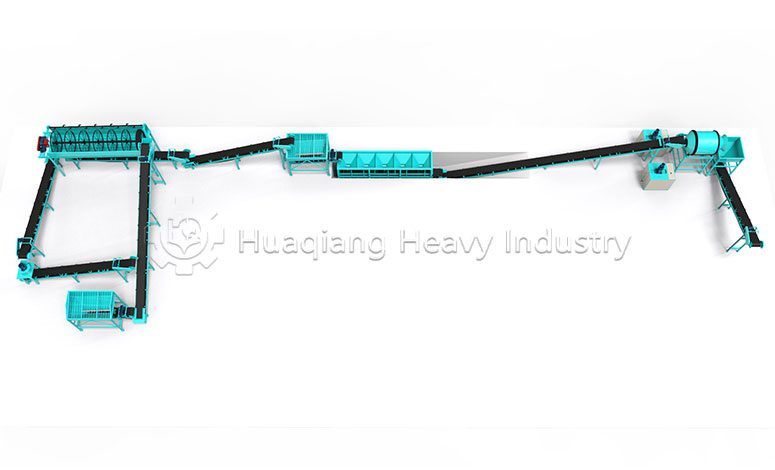
Conflict 2: Drastically different processing temperatures. Bulk-blending lines operate entirely at ambient temperature without water or heat; the core function of NPK blending machines and lines is “shape-preserving mixing.” In contrast, bio-organic fertilizer granules contain 25%–35% moisture after disc granulation and must be dried before packaging and storage. The critical temperature limit for drying is 60°C; exceeding this causes massive die-off of functional bacteria. This necessitates a low-temperature, high-airflow drying system for bio-organic fertilizer, whereas bulk-blending lines require no drying at all. These two drying requirements cannot be met by the same equipment.
Conflict 3: Disparate cleanliness standards. For blended fertilizer production lines, incomplete cleanout during a formula switch merely results in nutrient deviations; however, for bio-organic fertilizer lines, incomplete cleanout allows residual chemical fertilizer dust or contaminating microorganisms to taint the next batch, causing the live bacterial count of the entire batch to fall short of standards. The cleaning frequency, cleaning methods, and validation criteria for the two types of lines differ completely.
Where can the lines feasibly share infrastructure? If maximizing equipment utilization is a priority, the initial raw material storage and crushing stages may be shared, provided that physical isolation is implemented: chemical and organic raw material silos must be kept separate, and crushing equipment must be dedicated to specific materials. From the mixing stage onwards, the two production lines must remain completely independent. The bio-organic fertilizer disc granulator and its associated low-temperature drying system should be housed in a separate room from the blended fertilizer mixing and packaging line to prevent cross-contamination via dust.