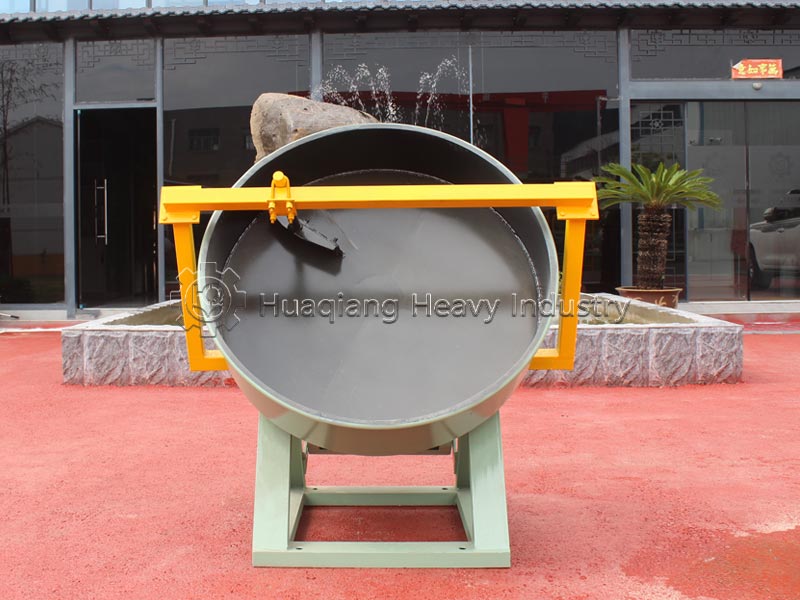
The Primary Causes of Irregular Granules in Organic Fertilizer Disk Granulator Machines
Improper raw material management is the leading culprit. An imbalance in material moisture content is a key factor: if the material is too dry, it resists rolling and molding, resulting in flat or fragmented granules; conversely, if it is too wet, it becomes sticky and clumps together, forming elongated rods or fused, irregular masses. Furthermore, incomplete pulverization of raw materials—leaving behind hard lumps or coarse fibers—hinders the uniform rolling and polishing of granules, leading to deformed shapes. When highly viscous manure-based materials are not blended with additives such as straw powder or bentonite to adjust their looseness, the resulting uneven viscosity also contributes to the generation of irregular granules.
A mismatch in the operational parameters of the organic fertilizer disk granulator machine disrupts the material’s molding trajectory. An inappropriate disc inclination angle is problematic: if the angle is too shallow, material accumulates and stagnates, hindering smooth rolling; if it is too steep, the material slides off too quickly, leaving insufficient time for proper shaping. Similarly, an excessive rotation speed can easily grind down the granules, while a speed that is too slow lacks the necessary kinetic energy for effective granulation, resulting in poor sphericity. Worn scraper blades or excessive gaps between the blades and the disc surface allow material to cake and accumulate on the disc bottom; this disrupts the natural flow curvature of the material layer, creates chaotic force distribution, and leads to the prolific generation of irregular granules.
Non-standardized operational procedures exacerbate the problem of irregular granules. Uneven water spraying creates significant localized moisture disparities, resulting in the simultaneous presence of sticky clumps in wet zones and loose, unformed particles in dry zones. Erratic feeding rates—characterized by sudden fluctuations in volume or frequent interruptions—cause instability in the thickness of the material layer on the disc surface, leading to inconsistent granule sizes and an increased prevalence of deformed shapes. Finally, a failure to promptly screen and recycle undersized fines or oversized lumps back into the granulation zone allows these irregular particles to repeatedly interfere with the normal rounding and shaping process, ultimately resulting in a persistently high proportion of irregular granules in the final product.