How can double roller granulator machines avoid wasting production resources?
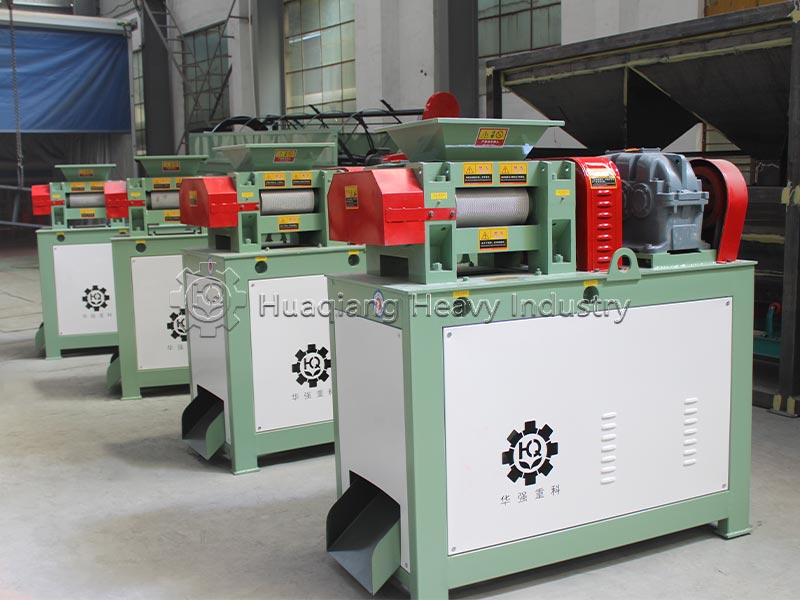
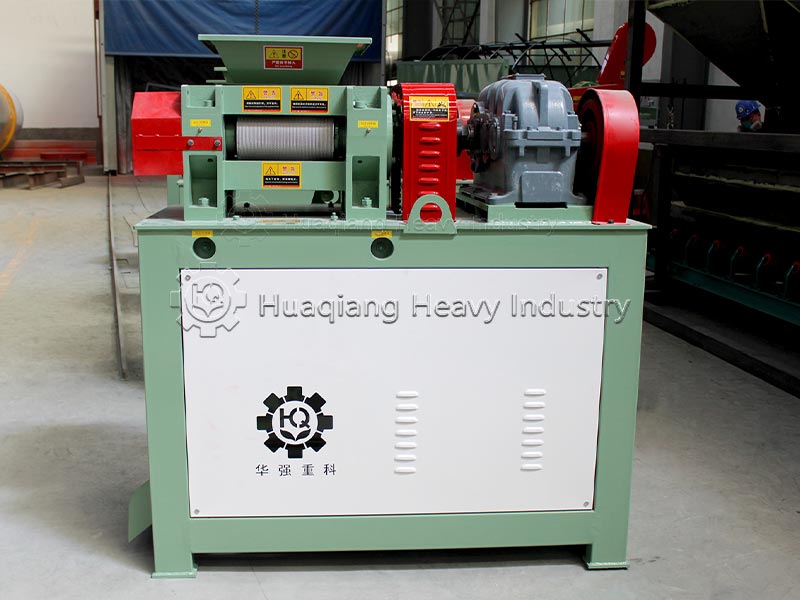
The double roller granulator machine avoids wasting production resources by focusing on four key areas: raw material pretreatment, precise equipment control, waste granule recycling, and operation and maintenance management. This reduces raw material loss, lowers energy consumption and downtime due to malfunctions, and improves resource utilization, making it suitable for continuous production of bio-organic fertilizer granulation or compound fertilizers.
Raw material pretreatment strictly controls moisture content (20%-25% for organic fertilizers, 5%-8% for compound fertilizers), screens particle size to ≤3mm and ensures uniform mixing, and precisely adds binders as needed to improve material formability and reduce material return from the source; it prevents contaminated or agglomerated materials from entering the machine, avoiding material sticking to the roller surface and clogging, thus preventing raw material loss and downtime waste.
The fertilizer roller press granulator operates with precisely adjusted parameters based on material characteristics, controlling the roller gap (0.2-0.5mm), roller pressure, and main motor speed to maintain uniform force on the roller surface, avoiding uneven pressure that causes uneven particle size and low molding rate; it uses variable frequency speed control for smooth start and stop, reducing equipment impact and ineffective energy consumption, while simultaneously monitoring current and temperature, immediately stopping and troubleshooting in case of abnormalities.
A closed-loop system for crushing and screening returned materials is provided, crushing and reusing all unqualified granules and returned materials from granulation, achieving zero raw material waste and significantly improving overall utilization; dust removal and collection devices are configured as needed to reduce raw material dust loss during production.
Daily equipment maintenance is crucial, including checking roller surfaces and bearings before each shift, promptly replacing worn roller skins and cleaning sticky materials, and regularly lubricating and tightening vulnerable parts to reduce downtime due to malfunctions; standardized employee operation prevents production abnormalities and resource loss caused by incorrect parameter adjustments, ensuring stable and efficient equipment operation.