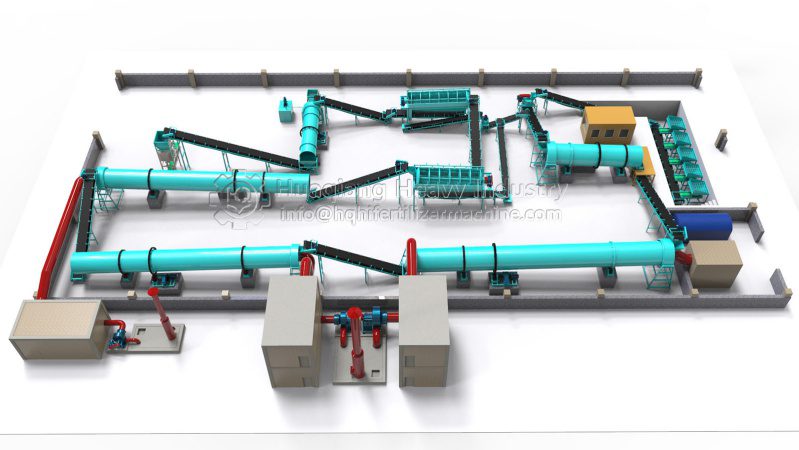
Are there significant differences in the raw materials used in NPK blending machine?
The basic raw materials used in NPK blended fertilizer (BB fertilizer) vary greatly, which is a key reason why NPK blending fertilizer production lines must be specifically designed.
The differences in raw materials are mainly reflected in specific gravity, particle size, moisture content, flowability, and corrosivity. Common nitrogen sources include urea, ammonium sulfate, and ammonium chloride; phosphorus sources include monoammonium phosphate, diammonium phosphate, and superphosphate; and potassium sources include potassium chloride and potassium sulfate. Different raw materials have significantly different bulk densities; urea is light, ammonium phosphate is relatively heavy, and some fillers are even lighter. These differences in specific gravity easily lead to stratification and segregation, resulting in inaccurate proportions.
Inconsistent particle size also causes serious problems. Large particles sink, while fine powder floats. Even with good mixing, stratification will occur again during conveying, lifting, and packaging, resulting in uneven nutrient distribution in the finished product. Simultaneously, differences in raw material moisture content mean that urea and potassium chloride are prone to absorbing moisture and clumping, while excessive fine powder will adhere and bridge, affecting the stability of the feed.
Differences in corrosivity are also significant. Ammonium chloride, potassium chloride, and other chlorine- and sulfur-containing raw materials are highly corrosive to ordinary carbon steel equipment. Without anti-corrosion treatment, the equipment’s service life will be significantly shortened.
Because of the significant differences in raw materials, NPK blending machine has strict requirements for its configuration: a high-precision static/dynamic batching system must be used to ensure accurate metering; the mixer must be a fast, dead-angle-free, low-fragmentation type to avoid damaging particles; the lifting and conveying equipment must prevent segregation and material sticking; and parts in contact with the raw materials must be treated with anti-corrosion measures.
Simply put: the greater the difference in raw materials, the higher the requirements for the precision, structure, and materials of the equipment. Only when the equipment is matched to the characteristics of the raw materials can NPK blended fertilizer with uniform and stable nutrients be produced.