
One Question per Station: The Three “Oral Exams” Materials Face on a Fertilizer Production Line
On a fertilizer production line, materials pass through numerous pieces of equipment from the moment they enter the facility until they are bagged. Yet, what truly determines whether a material can proceed further is often not the horsepower of the machinery, but the specific question posed at each stage. The multiple-silo, single-weigh static batching system asks, “How much do you weigh?” The double-roller press granulator asks, “Are you dry enough?” And the bio-organic fertilizer production line asks, “Are you still alive?” These questions may seem simple, but fail any one of them, and the material must be sent back to start over.
The question at the first station is the most fundamental—and leaves no room for ambiguity. The multiple-silo single-weigh static batching system doesn’t care what the material looks like or where it came from; it recognizes only one figure: weight. Materials from various silos are discharged sequentially into a single weigh hopper, with a reading recorded for each addition. Only once all components have been weighed is the batch released. The term “static” is key here: because the material is weighed while stationary—unaffected by fluctuations in conveyor speed or the impact of falling material—the sensors capture a stable load, ensuring that the margin of error in the proportions remains extremely small. This stage establishes the “identity profile” for the entire batch: the specific ratios of nitrogen, phosphorus, and potassium are locked in from this moment forward. All subsequent processes are merely physical treatments based on these established proportions; the formula cannot be altered thereafter.
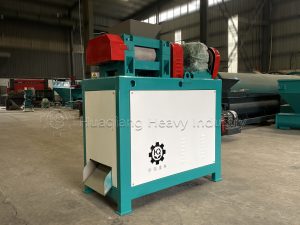
The question at the second station is more demanding. The double-roller press granulator’s primary inquiry concerns moisture content: “Are you dry enough?” Its operational design leaves no room for compromise: two high-strength rollers, rotating toward each other, instantly compress powdered material into thin sheets at room temperature. The process involves no added water and no increase in temperature; the bonding force between particles is generated entirely through intermolecular forces under high pressure. If the moisture content is too high, the damp material will slip between the rollers, resulting in an uneven thickness of the pressed sheets. Conversely, if the moisture content is too low, the material becomes too fluid to form a continuous layer, leading to inconsistent intake by the rollers. Therefore, the acceptable range at this stage is not merely “dry enough,” but rather a very narrow window. For this reason, the moisture control measures implemented during the preceding fermentation and crushing stages are, in effect, laying the groundwork for success at this specific station.
The challenges at the third stage are the most unique—and the least forgiving. During the granulation and drying phases of a bio-organic fertilizer production line, the critical question is: “Are you still alive?” Here, “you” refers to the invisible, functional microorganisms within the material. Common strains, such as Bacillus subtilis, are extremely sensitive to temperature; if the drying temperature exceeds their tolerance threshold, the microbes will perish en masse. In such a case, no matter how perfectly round or firm the granules may be, the core value of the bio-organic fertilizer is lost. Consequently, the drying process must employ a multi-stage temperature control strategy: first, rapidly evaporating surface moisture, then gradually drawing out moisture from deeper within—all while keeping the material’s temperature strictly within the range that the microorganisms can withstand. This stage tests not just physical parameters, but adherence to process discipline; a deviation of even a few degrees in the temperature profile can compromise the biological activity of the entire batch.
Once these three stages are complete, the fate of the material is essentially sealed: the proportioning stage locks in the composition, the extrusion stage locks in the physical form, and the biological processing stage locks in the microbial activity. No stage can be bypassed, nor can one stage serve as a quality gate for the next. The reliability of fertilizer production is built precisely upon this division of labor—where each stage focuses on one specific requirement before clearing the material for the next step.