
【FAQ】Why is clearing the equipment more critical than adjusting parameters when switching fertilizer formulations?
When changing formulations on a fertilizer production line, operators often focus immediately on adjusting batching scale parameters, mixing times, and roller gaps. In practice, however, the primary reason the first batch of a new product fails to meet specifications is rarely incorrect parameter settings; rather, it is the failure to thoroughly clear out the remnants of the previous production run.
Bulk Blended (BB) Fertilizer Lines: Even 1% residue can alter nutrient content. In the BB fertilizer mixing process, material from the previous run often adheres to the inner walls of the mixer, the mixing paddles, and the edges of the discharge gate. For instance, when switching from a 15-15-15 to a 28-6-6 formulation, if residue accounts for just 1% of the new batch, the total nitrogen content could deviate by more than 0.1%. If the previous formulation contained micronutrients, a mere 0.1% residue could cause the micronutrient levels in the new batch to exceed limits by several times. Similarly, in systems using multiple silos and a single static weigh hopper, residue left in the raw material silos, weigh hoppers, or feeding augers can skew the weighing baseline for the subsequent batch. The proper clearing sequence is: empty the silos and weigh hoppers, clean the mixer, and finally perform a “purge run” using the base ingredients of the new formulation, which are then discharged.
Roller Press Granulation Lines: Residue affects roller surface conditions. In double-roller press granulation, if material from the previous run remains on the roller surfaces or inside the crusher, it will mix with the new material, leading to inconsistent granule color and fluctuations in granule strength. Standard operating procedures for roller press granulation require running the equipment empty to clean the roller surfaces, ensuring no material remains in the roller gaps. This should be followed by a trial run at a low feed rate; only once the compacted material (flakes/sheets) reaches the required density should the line be returned to full-load production.
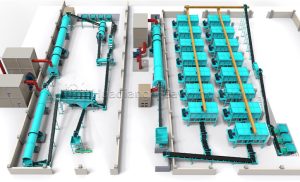
Bio-organic Fertilizer Lines: Clearing the equipment is a hygiene imperative. In the production and granulation of bio-organic fertilizers, clearing the equipment is not just about preventing nutrient cross-contamination—it is also essential for avoiding contamination by unwanted microorganisms or chemicals. Any residual chemical fertilizer dust or material from a previous run can inhibit the activity of the functional microorganisms (beneficial microbes) in the product. Mixers, granulating discs, and conveying equipment that come into contact with materials must be cleaned with clean water or a disinfectant solution and then dried. Following cleaning, samples should be taken for viable microbial count verification to ensure there is no residual contamination before the next batch of materials is introduced.
Verification of equipment clearance is even more critical than the cleaning process itself. After a formula change, the first batch of product must be stored and sampled separately; it should only be integrated into the main production lot once it has passed testing for nutrient content and viable microbial counts. Maintaining detailed records—covering the sequence of equipment clearance, the specific areas cleaned, and the verification results—is a more effective way to ensure that the initial production run following a formula change consistently meets quality standards than repeatedly adjusting process parameters.