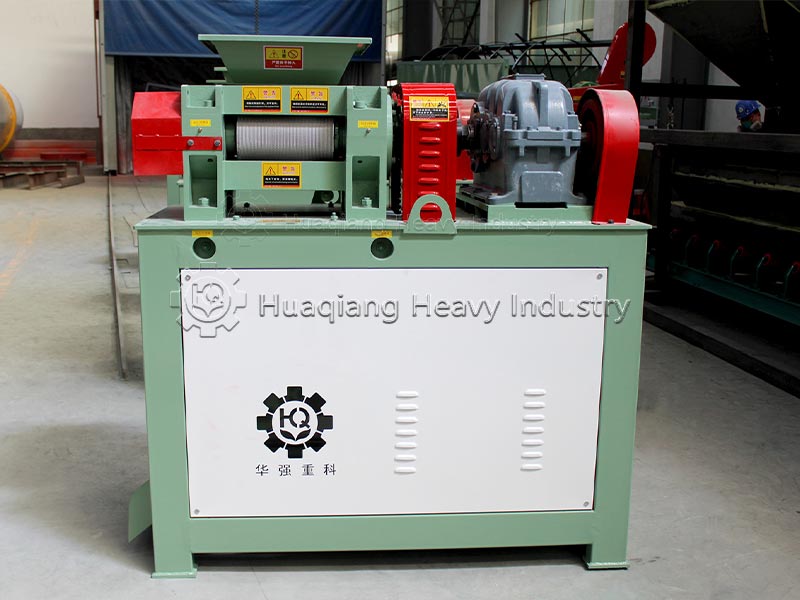
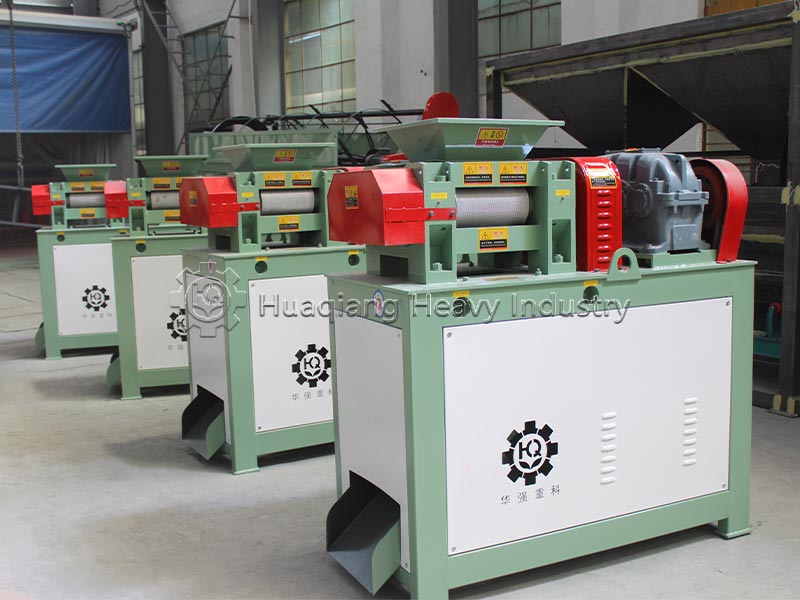
What are the disadvantages of processing NPK blended fertilizers with a fertilizer roller press granulator?
While using a fertilizer roller press granulator machine to process NPK blended fertilizers offers significant advantages, it also has several drawbacks:
1. Strict requirements for raw material moisture content: The moisture content of the raw materials needs to be precisely controlled within a specific range. Excessive moisture can easily lead to particle adhesion and equipment blockage, while insufficient moisture makes it difficult to form granules. This requires strict control over the raw material pretreatment process.
2. Limited particle shape: The finished product is mostly in the form of flattened or cylindrical granules, making it difficult to produce spherical or other diverse shapes of fertilizers. This limits competitiveness in market scenarios where specific particle appearance is required.
3. Equipment wear and tear: The mineral components in NPK raw materials cause continuous wear on the roller surface, requiring regular replacement of the rollers, increasing maintenance costs and downtime.
4. Not suitable for highly viscous raw materials: If excessive amounts of highly viscous components such as humic acid and amino acids are added to the blended fertilizer, they can easily adhere to the roller surface and conveying parts, affecting granulation stability and potentially causing production interruptions in the fertilizer roller press granualtor produciton line.
5. High requirements for raw material mixing uniformity: NPK blended fertilizers require the mixing of various basic fertilizers in specific proportions. If the mixing is uneven during the pretreatment stage, it can lead to localized nutrient imbalances in the granules, affecting the overall quality of the fertilizer. This requires the use of high-efficiency mixing equipment, increasing process complexity and initial investment.
6. Significant variations in particle strength: Due to factors such as raw material particle size distribution, moisture fluctuations, and roller pressure parameters, the produced granules have uneven hardness. Some granules are prone to breaking during transportation and storage, generating powder. This not only reduces product marketability but can also lead to nutrient loss and environmental pollution.