
Localization Practices of NPK Fertilizer Production Lines in Regional Adaptation
Soil fertility, climate conditions, and crop types vary significantly across different regions, leading to diverse demands for NPK compound fertilizers. In recent years, the localized adaptation and modification of NPK fertilizer production lines have become a crucial measure to promote regional agricultural development, making compound fertilizer production more aligned with local agricultural practices and helping farmers improve quality and increase income.
In the arid and semi-arid regions of northern my country, NPK fertilizer production lines have focused on optimizing coating and slow-release technologies and water-saving formulations. The resulting slow-release compound fertilizers can reduce fertilization frequency by 50%, effectively retaining soil moisture and nutrients, and meeting the growth needs of drought-resistant crops such as corn and potatoes. For example, a fertilizer company in Inner Mongolia has modified its NPK fertilizer production line to customize a compound fertilizer with an NPK ratio of 18-10-12 based on the local sandy soil fertility, helping to increase corn yield by nearly 200 catties per mu.
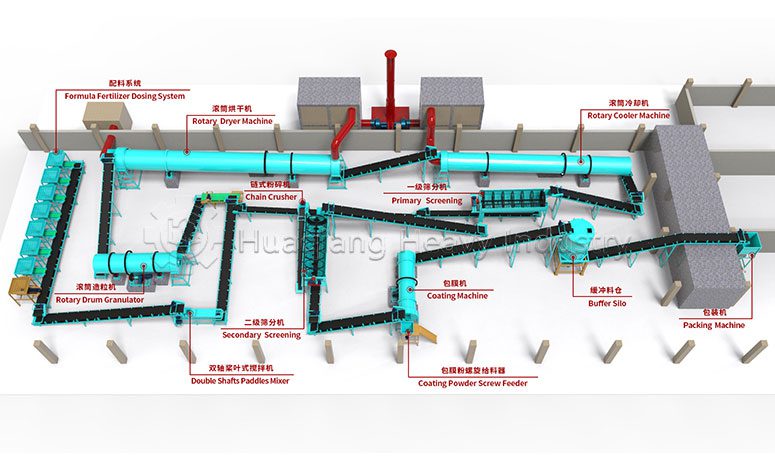
In the rainy regions of southern China, NPK fertilizer production lines focus on improving the fertilizer’s resistance to leaching. By improving the granulation process and increasing granule hardness, nutrient loss due to rainwater runoff is reduced. Simultaneously, for characteristic crops such as rice and citrus, the formula ratio is adjusted, increasing the potassium content to enhance crop resistance to waterlogging and improve fruit quality.
Localization practices in overseas markets have also yielded significant results. NPK fertilizer production lines in Malaysia are adapted to the tropical climate, producing high-potassium compound fertilizers to support the growth of cash crops such as oil palm and rubber; NPK fertilizer production lines in Africa have optimized raw material adaptability, utilizing readily available local phosphate resources to reduce production costs and make high-quality compound fertilizers accessible to more farmers. Localized adaptation allows NPK fertilizer production lines to truly take root in the region and empower agricultural development.