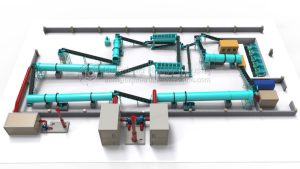
Comprehensive Process Optimization for NPK Blending Fertilizer Production Lines
NPK blending fertilizer production lines feature a streamlined process and simple raw materials; however, they are prone to issues such as inaccurate formulation ratios, segregation and stratification, caking, excessive dust generation, and low efficiency. Through comprehensive process optimization, it is possible to enhance precision, boost output, minimize material loss, improve environmental compliance, and ensure consistent product quality.
First, the raw material pretreatment stage is optimized. Granular raw materials undergo classification and screening to remove fines, lumps, and impurities, thereby ensuring particle uniformity, consistent hardness, and comparable moisture levels. The closer the raw materials are in terms of particle size and specific gravity, the more uniform the final blend will be; this minimizes issues such as segregation during transport, uneven nutrient distribution, and color discrepancies, effectively reducing the volume of returned materials and substandard products at the source.
Second, the automated batching and metering system for the NPK blending machine is optimized. By employing a multi-bin static automatic batching system—featuring differential weighing and variable-frequency feeding—metering precision is enhanced on a per-second basis, keeping the margin of error within ±0.2%. The addition of online calibration and “one-touch” recipe switching capabilities allows for rapid transitions between various formulations of nitrogen, phosphorus, potassium, and macro/micro-elements. This ensures production flexibility, minimizes human error, and significantly boosts the yield of qualified finished products.
Third, the processes for conveying, elevating, and finished product packaging are optimized. The system utilizes low-drop-height transfer points, cushioned conveying mechanisms, and enclosed bucket elevators to minimize particle breakage and prevent secondary segregation. Anti-caking and moisture-proofing devices are installed—supported by integrated dehumidification and dust removal systems—to ensure that finished products remain free of caking and enjoy an extended shelf life. Automated quantitative packaging systems are implemented to ensure high speed, minimal weight deviation, and reduced labor requirements.
Finally, the electrical control linkages and the eco-friendly, energy-saving layout are optimized. The entire production line is governed by a centralized PLC system featuring one-touch control, interlocked start-stop sequences, and automated fault alarms; this minimizes idle running time and reduces energy consumption. The system is equipped with comprehensive dust removal and collection equipment, ensuring zero external dust emissions while maintaining a compact footprint and facilitating simple operation and maintenance. Following this comprehensive optimization, the blended fertilizer production line achieves precise formulation ratios, high blending uniformity, minimal material loss, full environmental compliance, and lower operating costs, making it ideally suited for large-scale, continuous production operations.