
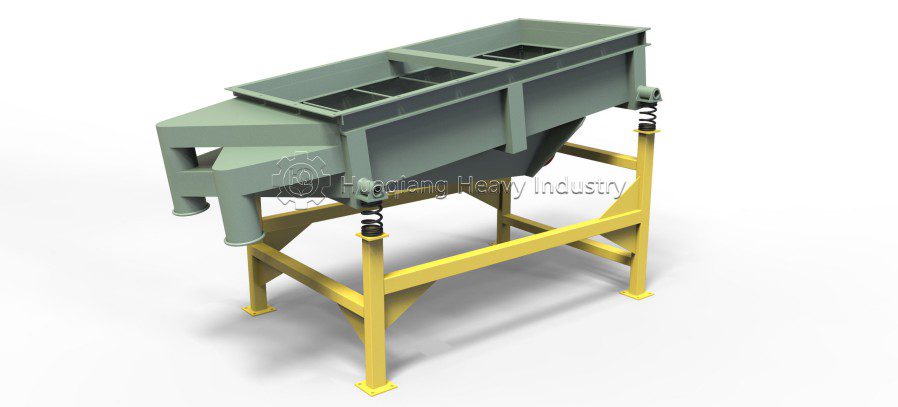
The core working component of a vibrating screen is its vibration system, which determines the equipment’s screening efficiency, processing capacity, and operational stability. A vibrating screen uses a vibrating motor as the vibration source, causing the material to be thrown up on the screen mesh while simultaneously moving forward in a linear motion. The vibration system consists of a vibrating motor (or exciter), eccentric blocks, damping springs, etc., and its working principle and parameter adjustments directly affect the screening effect.
There are two main types of vibration systems for vibrating screens: linear vibration systems and circular vibration systems. Linear vibration systems use dual vibrating motors driven by synchronously rotating in opposite directions to generate linear excitation force. Circular vibration systems use a cylindrical eccentric shaft exciter; the centrifugal inertial force of the unbalanced mass causes the screen box to achieve circular vibration. Understanding the working principle and adjustment methods of the vibration system is key to fully utilizing the performance of a vibrating screen.
The vibration system of a vibrating screen mainly consists of the following components:
(I) Vibrating Motor (Exciter): This is the power source that generates vibration. The vibrating motor directly vibrates the screen. Fertilizer screens use a dual-shaft inertial exciter, driven by two motors respectively. The vibrating motor generates periodic inertial force when rotating.
(II) Eccentric Block (Weight): Installed on the shaft of the vibrating motor or exciter, the amplitude is changed by adjusting the position or weight of the eccentric block. The upper rotating weight causes the screen surface to produce planar rotary vibration, while the lower rotating weight causes the screen surface to produce conical rotary vibration; their combined action produces compound rotary vibration.
(III) Vibration Damping Spring Device: Used to support the screen body and isolate the transmission of vibration to the foundation. The screen body is supported by springs under the frame. The springs effectively reduce the impact of equipment vibration on the foundation.
(IV) Screen Box and Screen Mesh: These are the load-bearing components of the vibration. The screen mesh is fixed inside the screen box and vibrates together with the screen box.
The screen of a vibrating screen is the core working component for material grading. The screen is made of woven metal wire with square holes or expanded metal mesh, and materials include low-carbon steel, brass, and stainless steel.
Multi-layer screen grading: When installing multiple layers of screens, the screens with larger apertures are on top, and those with smaller apertures are on the bottom. Material passes through each layer of screens from top to bottom. Large particles are trapped by the upper screens, medium-sized particles by the middle screens, and fine particles pass through all screens and are discharged from the bottom.
Screen fixing: The screens are tightened with special tensioning plates, making installation, disassembly, and maintenance convenient and ensuring reliable operation.
The vibrating screen is located after the cooler and before the packaging machine in the fertilizer production line. It forms a closed-loop return material circulation system with the granulator.
The main groups of people who need vibrating screens include: equipment technicians; production line process designers; and equipment managers.