
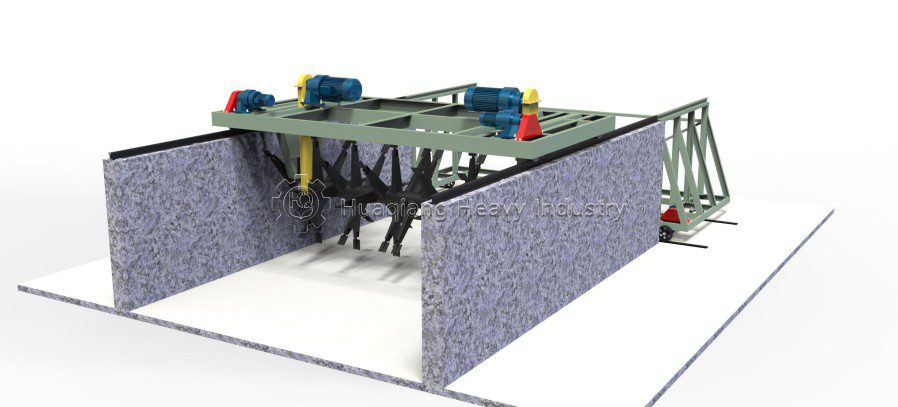
Simple Compost Turning Machine
The simple compost turner is a mechanized turning device specifically designed for small-to-medium-scale channel-style fermentation. Its core structure consists of a turning mechanism operating along fixed rails mounted on the fermentation channel; an electric motor drives the rotation of the turning tines to ensure uniform turning and aeration of the organic raw materials. The equipment features a simple, compact design that is easy to install and requires no complex commissioning.
The design of this compost turner fully addresses the practical needs of small-to-medium-scale producers. It eliminates the need for large-scale factory buildings or complicated installation procedures; it can be put into operation quickly after the construction of simple concrete or steel-structure fermentation channels. Specifications can be flexibly customized to match the dimensions of the fermentation channels, offering a range of turning widths from 1.2 to 4 meters.
System Composition and Technical Architecture
The technical architecture of the simple compost turning machine can be divided into the following levels:
(1) Mechanical execution layer: It is composed of a turning drum and rake teeth. It is an execution component that directly acts on the material. The blades on the drum are distributed in a spiral. The rake teeth are made of high-strength and wear-resistant steel.
(2) Power transmission layer: composed of motor, reducer, sprocket and chain. Cycloidal pinwheel reducer is used to achieve smooth transmission.
(3) Traveling displacement layer: It is composed of traveling motor, transmission gear and traveling wheel. It adopts track-type walking design.
(4) Depth adjustment layer: composed of a winch or hydraulic lifting device.
(5) Control layer: It consists of centralized control cabinet, button switch and limit travel switch.
Industry Applications and Process Compatibility
The simple compost turner is suitable for small- to medium-scale aerobic composting processes. In organic fertilizer production, it can process organic waste such as livestock and poultry manure. In environmental protection, it can be used for the aerobic composting of municipal sludge. In agriculture, it handles agricultural waste such as crop stalks. In the industrial sector, it can process industrial organic waste such as sugar mill filter mud and distillery grains.
Material Suitability Analysis
The simple compost turner demonstrates strong adaptability to various materials. Material types: It can process a wide range of organic wastes, including livestock and poultry manure, sludge, straw, filter cake, and dregs. Moisture content: It is suitable for materials with a moisture content of 50%–70%. Pile depth: The turning depth ranges from 0.6 to 1.8 meters. Pile width: The turning width accommodates fermentation channels ranging from 1 to 4 meters. The equipment transforms viscous, dense raw materials into a loose, aerated state with optimal porosity.
Core Principles and Operating Mechanisms
The core operating principle of the simple compost turner relies on the synergy between rail-guided movement and the turning/pulverizing action. During operation, the equipment travels smoothly along rails on both sides of the fermentation channel, while a motor drives the turning drum to rotate at high speed. Rake teeth mounted on the drum turn, pulverize, and mix the material within the channel. Three key tasks are accomplished during this process:
Mixing and Pulverizing: The rake teeth thoroughly break up and pulverize compacted material, resolving issues with material caking.
Oxygenation and Ventilation: The turning action causes the material to tumble continuously, ensuring full contact with the air and rapidly replenishing oxygen within the compost pile.
Displacement and Mixing: Helically arranged blades push the material forward by 0.2 to 1 meter while simultaneously turning it.

Comparison with large-scale turning equipment
Compared to other composting equipment, the simple compost turner offers distinct advantages:
Compared to large-scale trough-type turners: It features a simplified structure and compact size, occupying only one-third of the footprint of large equipment. It requires no complex civil engineering; simple excavation of a fermentation trough is all that is needed to put it into operation. Equipment investment costs are reduced by over 50%, and operational complexity is significantly lowered, eliminating the need for specialized technical personnel.
Compared to manual turning: Efficiency is increased several-fold, and labor intensity is drastically reduced. It ensures uniform turning and thorough aeration, shortening the fermentation cycle by more than 30%.
Summary of core advantages: The simple compost turner offers significant benefits in terms of purchase cost (only one-third to one-half that of large equipment), ease of operation (average workers can master it with just half an hour of training), footprint (only one-third that of large equipment), and maintenance costs (streamlined structure with few wear parts).
Key Selection Criteria and Procurement Recommendations
When selecting a simple compost turner, focus on the following key points:
1. Fermentation tank dimensions: Choose a model that matches the width and depth of your tank. Select a compact model for small tanks (1.5–2.5 meters) and a standard model for medium-sized tanks (2.5–3.5 meters).
2. Processing scale: Determine equipment specifications based on daily processing volume, allowing for a 10% capacity margin.
3. Equipment quality: Prioritize models featuring wear-resistant tines and appropriately matched motor power; also consider ease of operation.
4. After-sales service: Opt for manufacturers with comprehensive after-sales support to ensure access to installation guidance, operational training, and maintenance services.
Models and Specifications of Simple Compost Turners
| Simple Compost Turning Machine | ||||
| Model | Main Motor | Walking Motor | Lifting Motor | Mobile Car Motor |
| FD3 | 7.5kw*2 | 1.5kw | / | 1.5Kw |
| FD4 | 11kw*2 | 1.5kw | / | 1.5Kw |
| FD5 | 15kw*2 | 2.2kw | 0.75kw | 1.5Kw |
| FDT3 | 7.5 kw*2 | 1.5kw | 0.75 kw | 1.5Kw |
| FDT4 | 11kw*2 | 1.5 kw | 0.75 kw | 1.5Kw |
| FDT5 | 15kw*2 | 2.2 kw | 0.75 kw | 1.5Kw |