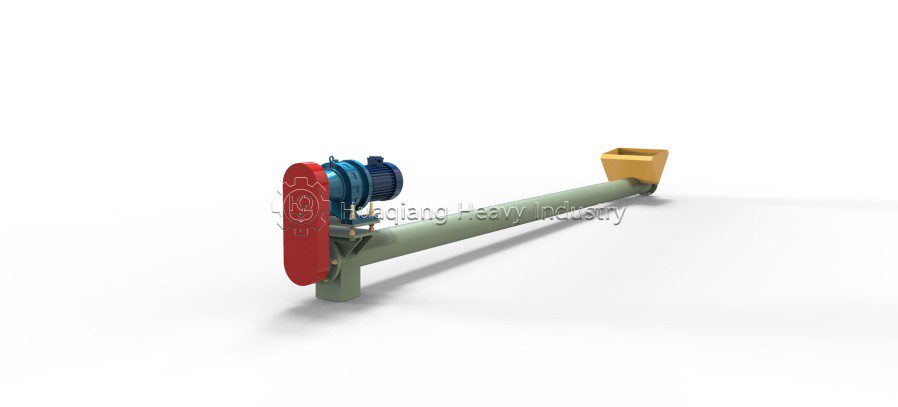
Screw conveyors are suitable for conveying non-sticky, wet materials in powder, granular, and small lump form. Shaftless screw conveyors are suitable for sticky and easily entangled materials.
Working principle of the equipment
The rotating helical blades push the material along the fixed casing. The material’s own weight and the frictional resistance of the casing prevent the material from rotating with the helical blades, and instead causes it to move axially.
Equipment operation method
(I) Pre-start Inspection: Check all fastening bolts on the screw conveyor for looseness. Check the lubrication condition of all bearings. Check the oil level in the reducer to meet requirements.
(II) No-load Start: Start without load. Starting with material is strictly prohibited.
(III) Operation Monitoring: Feeding should be uniform. Observe the equipment operation carefully to ensure it is normal.
(IV) Shutdown Procedure: Stop feeding first, and stop the machine only after the material has been discharged.
Equipment maintenance methods
(I) Daily Inspection: Inspect the machine’s operation daily. Check for leaks in the seals. Check for loose fasteners. Check the wear of the helical blades.
(II) Regular Maintenance: Lubricate the reducer according to the instruction manual. Change the oil after the reducer has operated for 2000 hours.
(III) Lubrication Management: Inject approximately 5 grams of lithium-based grease into the bearing housings at both ends every half month. Regularly add grease to the hanger bearings.
Common problems with the equipment
(i) Material blockage: Material accumulates inside the machine casing. Causes include uneven or excessive feeding, high material moisture content, and blockage at the discharge port.
(ii) Difficulty starting: The motor starts weakly with unusual noises. Causes include a missing phase in the power supply and material buildup inside the casing.
(iii) Abnormal noise: A harsh noise is emitted during operation. Causes include the spiral blades rubbing against the casing, worn hanger bearings, and damaged bearings.
(iv) Material leakage: Material leaks from the shaft end, flange connection, or cleaning door. Causes include damaged sealing devices and loose flange bolts.
(v) Spiral shaft breakage or bending: Causes include prolonged overload operation, the presence of hard foreign objects in the material, and worn intermediate hanger bearings.
(vi) Broken connecting bolts: Loose or broken connecting shaft bolts. Causes include insufficient bolt strength and loosening due to prolonged vibration.