
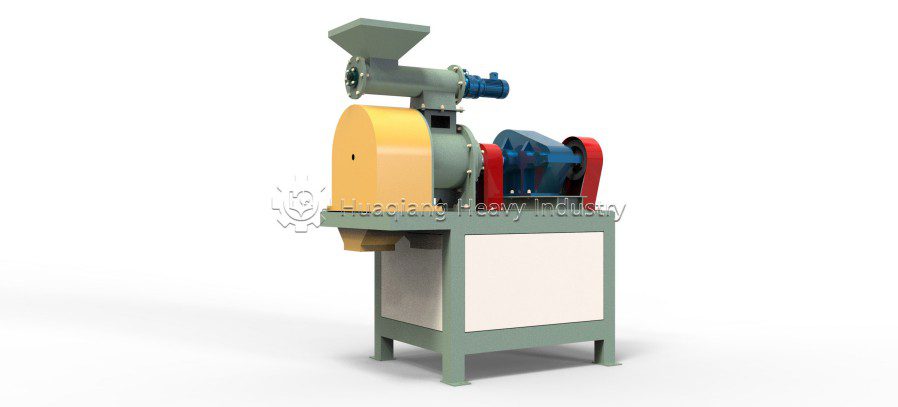
Ring Die Pelleting Machine
The ring-die pellet mill is a dry or wet granulation device that operates on the principle of extrusion molding via a die and rollers. Based on structural design, these mills fall into two main categories: horizontal ring-die pellet mills and vertical ring-die pellet mills. The horizontal type is currently the most widely used; it features a horizontally mounted ring die, with material entering the granulation chamber from the side. In contrast, the vertical type employs a configuration with the die facing upward and vertical material feeding, which facilitates heat dissipation and cooling within the granulation chamber. Regarding drive mechanisms, they are classified into two types: belt-driven and gear-driven.
System Composition and Technical Architecture
The technical configurations of ring-die pellet mills primarily include:
Horizontal ring-die pellet mill—The ring die is mounted horizontally and driven to rotate by the power source. Material enters the pelleting chamber via a side-mounted inlet using a mechanical forced-feeding system. This type features mature technology and high output, making it the mainstream choice for medium-to-large feed mills.
Vertical ring-die pellet mill—The die is oriented upwards, allowing material to be fed vertically and delivered directly into position. The die remains stationary while the rollers rotate, distributing material evenly around the perimeter via centrifugal force. The vertical structure of the ring die facilitates heat dissipation within the pelleting chamber, thereby overcoming the cooling limitations associated with horizontal models.
Industry Applications and Process Compatibility
Ring-die pellet mills are suitable for a wide range of industries. In the feed industry, they are used to produce complete-formula pellet feeds for livestock, poultry, and aquatic animals. In the organic fertilizer industry, they manufacture bio-organic fertilizer pellets. In the biomass energy sector, they produce fuel pellets from materials such as sawdust and straw. In the chemical industry, they are used to granulate various powdered chemical raw materials. Ring-die pellet mills offer significant advantages in the production of concentrated feed; their high output and low energy consumption make them the dominant choice for large-scale feed processing.
Material Suitability Analysis
Ring-die pellet mills have relatively high requirements regarding material suitability. Moisture content: Before conditioning, the material’s moisture content should generally be below 13%; after conditioning, the optimal range is 15%–16.5%. Particle size: Raw materials must be ground into a powder with a particle size of less than 3 mm. Temperature: Conditioning temperatures typically range from 64°C to 85°C. If the material’s moisture content is too high (exceeding 18%), slippage is likely to occur between the inner wall of the ring die and the rollers, potentially preventing the formation of pellets altogether.
Core Principles and Formation Mechanisms
The core principle of the ring-die pellet mill is extrusion molding via the interaction between the die and the rollers. The pelletizing process involves the following mechanical stages: the deformation and compaction zone, where the material is gradually compacted and its density increases; and the extrusion molding zone, where pressure rises sharply and the material is forced out through the die holes. A wedge-shaped extrusion zone is formed between the inner wall of the ring die and the press rollers, subjecting the material within this zone to progressively increasing extrusion pressure. As the die and rollers rotate, the intake material is driven forward at an accelerating rate, while both the extrusion pressure and material density gradually rise. Once the extrusion pressure becomes sufficient to overcome the friction between the material and the inner walls of the die holes, the material is forced into the holes.

Comparative analysis with flat die pellet mill
Ring-die and flat-die pellet mills differ in several respects:
Feeding method: Ring-die mills utilize forced mechanical feeding, where material enters the pelleting chamber and is distributed by scrapers via high-speed centrifugal action, often resulting in uneven feeding; flat-die mills rely on gravity to feed material vertically into the compression chamber, ensuring uniform feeding.
Pressure: For dies of the same diameter, the roller diameter in a ring-die mill is constrained by the die diameter itself, limiting the pressure applied; in contrast, the roller diameter in a flat-die mill is not restricted by the die diameter, allowing for larger internal bearings.
Rotational speed and breakage rate: Ring-die mills operate at high speeds, resulting in a higher breakage rate for the discharged pellets; flat-die mills operate at low speeds, resulting in a lower breakage rate.
Roller adjustment method: Ring-die mills adjust pressure using two screws on an eccentric mechanism located at the center of the roller; flat-die mills employ a central adjustment mechanism based on a threaded post.
Output: Ring-die mills offer high output and low energy consumption, making them advantageous for large-scale production; flat-die mills have a lower output capacity.
Key Selection Criteria and Procurement Recommendations
When selecting a ring-die pellet mill, focus on the following key factors:
1. Production Capacity: Choose a model based on annual output. Select the SZLH25 model for an annual output of 1,000–3,000 tons; the SZLH350 model for 10,000–20,000 tons; and the SZLH400 model (or larger) for higher capacities.
2. Raw Materials: Horizontal ring-die pellet mills are preferred for pelletizing concentrate feeds; vertical ring-die pellet mills may be considered for high-fiber materials (such as straw or sawdust).
3. Quality: Prioritize models that feature a compact design, attractive appearance, high output, low energy consumption, ease of use, and reliable performance; also, check the material and heat treatment process of the ring die.
4. Service: Prioritize manufacturers with comprehensive after-sales support to ensure access to installation guidance, operational training, and timely maintenance services.
Production Capacity Data and Investment Reference
The production capacity of ring-die pellet mills ranges from 0.5 to 10 tons per hour. Small-scale models include the SZLH25 (0.5–1.5 t/h) and HKJ-250 (500–700 kg/h). Mid-sized models include the SZLH350 (3–6 t/h) and SZLH304 (1–3 t/h), while the large-scale SZLH400 offers a capacity of 4–10 tons per hour. Although the initial investment cost is higher than that of flat-die pellet mills, the investment and operating costs per unit of capacity are lower, making them suitable for large-scale production.
Ring Die Pellet Mill Models and Specifications
| Organic Fertilizer Ring Die Pellet Machine | ||
| Model | HP-450 | HP-650 |
| Capacity (t/h) | 2-5 | 4-8 |
| Pelleting Rate (%) | >95% | >95% |
| Motor Power(Kw) | 30+1.5 | 55+3 |
| Dimension(mm) | 2150*1350*2200 | 2500*1350*2535 |