
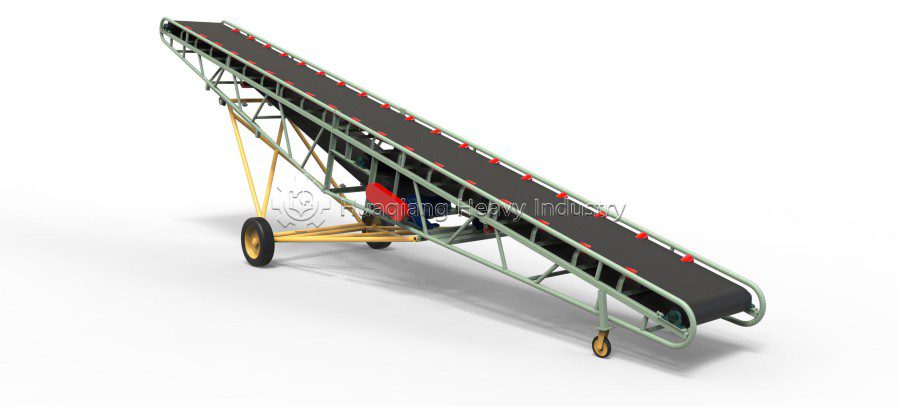
Mobile Belt Conveyor

Our Services

Have a
project in
mind?

Mobile Belt Conveyor

The mobile belt conveyor is a flexible, relocatable continuous conveying device widely used in short-distance transport scenarios requiring frequent changes in work locations. It consists of components such as the main frame, traveling wheels, a lifting mechanism, the conveyor belt, idlers, and pulleys.

Structural composition of the equipment

The main structure of the mobile belt conveyor comprises the main frame (steel tube construction), traveling wheels (pneumatic tires or steel wheels), swivel wheels, a lifting mechanism (electric or manual), the conveyor belt, idlers, drive and bend pulleys, a tensioning device, the drive unit, and the electrical control system.

Application scope of the equipment

Mobile belt conveyors are suitable for the short-distance transport of materials at locations such as ports, wharves, railway stations, coal yards, construction sites, sand and gravel yards, warehouses, mines, and fertilizer plants (including organic fertilizer facilities).

Equipment Features

Mobile belt conveyors are suitable for the short-distance transport of materials at locations such as ports, wharves, railway stations, coal yards, construction sites, sand and gravel yards, warehouses, mines, and fertilizer plants (including organic fertilizer facilities).

Types of usable raw materials

This equipment is capable of conveying bulk materials (such as coal, crushed stone, sand, cement, chemical fertilizers, grain, and ore) as well as individual items weighing less than 100 kg (such as bagged goods).

The working principle of the equipment

The working principle of a mobile belt conveyor is as follows: the conveyor belt loops around the head and tail pulleys to form a closed circuit, and the drive unit transmits power via the friction between the drive pulley and the belt, driving the belt to run continuously. Material is deposited onto the belt at the feed end and travels with it to the discharge end, where it is unloaded.

Equipment operating instructions

(I) Pre-start inspection: Thoroughly check the condition of all equipment components. Inspect the conveyor belt for misalignment, check that joints are secure, ensure idlers rotate freely, and verify that all fastening bolts are tight.
(II) No-load startup and operation: Start the equipment without a load and wait for normal operation before feeding material. Feed material evenly during operation to avoid overloading. Monitor the equipment’s operating status and shut it down immediately if any abnormalities are detected.
(III) Shutdown procedure: Stop feeding material first; cut off the power supply only after all material has been fully discharged from the belt.

Equipment maintenance methods

(I) Daily Maintenance: Clean up residual material and dust after each work shift. Inspect the conveyor belt for damage. Check the lubrication status of the roller bearings.
(II) Periodic Maintenance: Tighten bolts and nuts monthly. Regularly check the conveyor belt alignment. Periodically inspect idlers and other components. Calibrate the pressure valves of the hydraulic lifting system on a quarterly basis.
(III) Lubrication Management: Replenish lubricating oil in a timely manner. Avoid operating in damp environments to prevent rusting.