
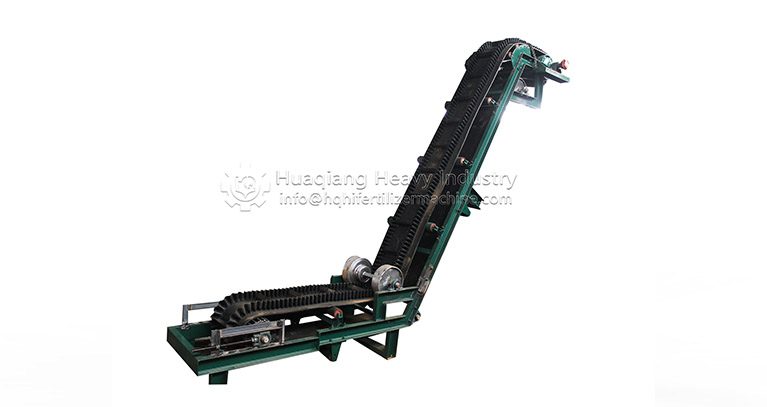
The large angle belt conveyor—also known as a sidewall belt conveyor or corrugated sidewall belt conveyor—is a specialized piece of conveying equipment designed to transport bulk materials at steep angles or even lift them vertically.
In practical operations, this type of conveyor effectively overcomes the limitations that prevent standard belt conveyors from functioning properly at steep inclines. By enabling the vertical or large angle lifting of materials within a confined space, it significantly reduces the equipment’s footprint and civil engineering investment. A single large angle belt conveyor can replace the traditional combination of a horizontal conveyor and a bucket elevator; this not only simplifies the process flow but also substantially lowers equipment procurement, operation, and maintenance costs.
The large angle belt conveyor is composed of multiple functional modules. The whole machine structure mainly includes the following core parts:
(1) Corrugated sidewall conveyor belt: The core traction and load-bearing component of the equipment, consisting of base belt, corrugated sidewall and diaphragm. The appearance of the base belt is similar to that of an ordinary conveyor belt, but it has greater lateral stiffness; the ribs are corrugated (can be sine wave, square wave, W-shaped wave, etc.), allowing the conveyor belt to bypass the convex and concave arc sections of each roller; the transverse partitions are arranged between the ribs on both sides at a certain distance, and can be divided into T-type, TS-type, C-type, TC-type, TCS-type, etc. according to the cross-sectional shape to adapt to different inclination angles and material characteristics.
(2) Driving device: including Y series motor and ZJ type shaft-mounted reducer, which provides the power required for equipment operation. The installation level error of the driving device must be controlled within 0.5 mm.
(3) Drive roller and reversing roller: The drive roller adopts a rubber surface design to enhance the adhesion with the conveyor belt; the reversing roller is used to change the movement direction of the conveyor belt. The surface of the roller needs to be kept clean and smooth to reduce wear on the conveyor belt.
(4) Idler roller group: including upper flat buffer rollers, parallel upper rollers, compound lower rollers, friction upper flat self-aligning rollers, friction lower self-aligning rollers and other types, which are set at different positions to ensure stable and reliable operation of the conveyor belt.
(5) Tensioning device: including a spiral tensioning device or a weight car-type tensioning device, used to adjust the tension of the conveyor belt to prevent it from slipping on the transmission roller.
(6) Frame and legs: It adopts a “Z” shape arrangement and is equipped with three types of intermediate frame legs: low, medium and high. The whole machine is divided into upper horizontal section, lower horizontal section and inclined section. The smooth transition of the conveyor belt is realized through the convex arc section and concave arc section frame between the upper and lower horizontal sections and the inclined section.
(7) Cleaner and safety device: including head cleaner and empty section cleaner, used to remove adhered materials on the conveyor belt; it is also equipped with backstops, deviation detection devices, longitudinal tear alarm devices, two-way pull rope switches and other safety protection devices.
Large angle belt conveyors have a wide range of applications, covering virtually all industrial sectors that require the continuous transport of bulk materials.
Coal industry: Used for transporting run-of-mine coal, clean coal, and gangue, both underground and on the surface. In underground coal mines, this equipment is critical for maintaining normal production at fully mechanized mining faces.
Metallurgy and mining industries: Used for transporting ores, mineral powders, sinter fines, iron ore concentrates, and similar materials.
Construction materials and cement industries: Used for transporting sand and gravel, aggregates, cement, limestone, gypsum, and related materials.
Chemical and fertilizer industries: Used for transporting fertilizer raw materials, finished fertilizer products, chemical powders, and more.
Grain and agriculture sectors: Used for transporting grains (such as wheat, corn, and rice) and feed ingredients.
Power generation and port industries: Used in coal handling systems for thermal power plants and for bulk cargo loading and unloading at port terminals.
Environmental protection and solid waste treatment: Used for material transport in environmental projects, such as municipal sludge handling and waste processing.
Additionally, steep-angle belt conveyors can be combined into integrated systems to meet specific process requirements, enabling the continuous transport of materials over long distances, across large spans, and at steep angles.
Large-angle belt conveyors can transport a wide variety of materials, covering almost all bulk materials. They are suitable for conveying bulk materials with a bulk density ranging from 0.5 to 4.2 t/m³ and a maximum particle size of 550 mm. Typical materials include coal, coke, ore, mineral powder, gravel, aggregates, sand, cement, lime, fertilizers, grains (wheat, corn, rice, etc.), wood chips, crushed glass, asphalt raw materials, and sintered fines. For special materials—such as those that are high-temperature, acidic, alkaline, oily, or contain organic solvents—sidewall conveyor belts made of specialized materials are required. The equipment operates reliably within an ambient temperature range of -25°C to +40°C.
The operating principle of a large angle belt conveyor is fundamentally the same as that of a standard belt conveyor; however, the key distinction lies in the use of a specialized conveyor belt featuring corrugated sidewalls and transverse cleats.
The operational process is as follows: the conveyor belt loops around the drive pulley and the return pulley located at either end of the frame, forming a closed circuit. When the drive unit rotates the drive pulley, the friction between the pulley and the belt propels the belt along a predetermined path. Material is fed onto the belt via a loading chute and transported toward the discharge end as the belt moves. During transport, the corrugated sidewalls prevent material from spilling off the sides, while the transverse cleats support the material and prevent it from sliding backward along the inclined section. It is precisely this “sidewall plus cleat” pocket-like structure that enables the safe, stable, and continuous transport of material across a wide inclination range—from 0° to 90°. Upon reaching the discharge end, the material is unloaded through the discharge chute under the combined influence of centrifugal force and gravity.