
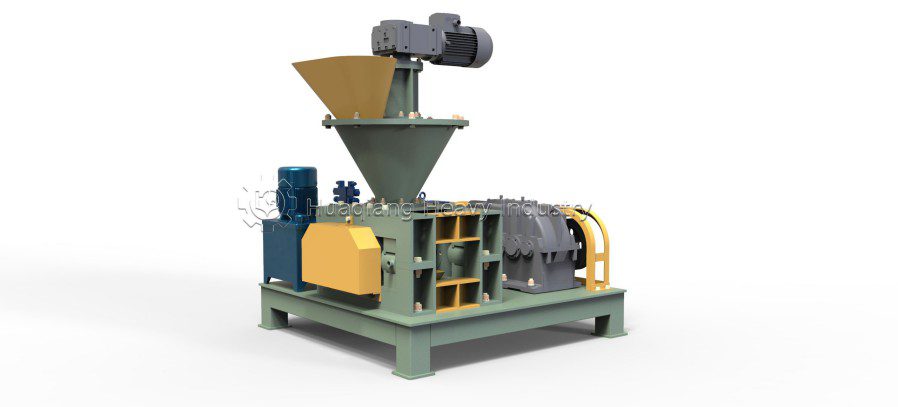
Hydraulic Roller Granulator
The hydraulic double-roller granulator is a powder forming equipment that adopts dry roller pressing process. Its core process is to compress the material through rollers to form flakes, which are then transformed into uniform particles through crushing, granulation and screening. This equipment does not require the addition of adhesives or drying processes, and can handle powdery materials with a moisture content of 2%-20%. The hydraulic double-roller granulator is the key equipment for ammonium chloride, ammonium sulfate and compound fertilizer granulation. It has mature technology, reasonable design and compact structure.
System Composition and Technical Architecture
The technical architecture of the hydraulic double-roll granulator can be categorized into the following layers:
(I) Hydraulic Power Layer: Comprising a hydraulic pump station, hydraulic cylinders, and a control valve assembly. It provides a stable, adjustable extrusion force (10–30 MPa). The hydraulic system features an automatic pressure-stabilizing design, maintaining pressure fluctuations within ±0.5 MPa.
(II) Mechanical Execution Layer: Consisting of a fixed roll and a movable roll. One set of roll bearing housings is fixed within the machine frame, while the other set moves along guide rails, pressed tightly against the first set by the hydraulic cylinders. The roll surfaces feature a regular arrangement of pockets (dimples) of uniform shape and size.
(III) Feed Control Layer: Comprising a volumetric feeder and a variable-frequency drive (VFD) system.
(IV) Post-processing Layer: Comprising a crusher, a vibrating screen, and a material return screw conveyor.
(V) Intelligent Control Layer: Comprising a PLC control system capable of adjusting pressure, roll gap, and feed rate.
Industry Applications and Process Compatibility
The hydraulic double-roller granulator is suitable for a wide range of industries. In the fertilizer industry, it can be used to granulate single-nutrient fertilizers and produce multi-nutrient compound fertilizers based on ammonium bicarbonate, urea, ammonium chloride, or potassium chloride. In the organic fertilizer sector, it can produce bio-organic fertilizers and organic fertilizers derived from municipal solid waste. In the chemical industry, it is suitable for granulating various powdered chemical raw materials. In the environmental protection sector, it enables the resource recovery of industrial waste by compressing it into granules. The equipment utilizes a drying-free production process, performing granulation at ambient temperature and achieving shaping in a single pass.

Material Suitability Analysis
The material requirements for the hydraulic double-roller granulator are as follows:
Moisture content: Generally, the moisture content should be between 2% and 5% (though some models can handle up to 20%). Excessive moisture leads to material sticking to the walls and clogging, while insufficient moisture results in a low granulation rate.
Pulverization fineness: Raw materials must be pulverized to a particle size of 60–100 mesh.
Impurity removal: Hard objects such as metal and stones must be removed from the raw materials.
Core Principles and Formation Mechanisms
The core operating principle of the hydraulic twin-roll granulator is based on the theories of external force extrusion and molecular bonding. Its forming process comprises the following stages:
Degassing and pre-compression stage: Various dry powder materials are fed into the top of the equipment, where they undergo degassing and screw pre-compression before entering the twin-roll assembly.
High-pressure extrusion stage: Under the immense extrusion force exerted by the twin rolls, the material undergoes plastic deformation and is compressed into sheets. The magnitude of the extrusion force can be adjusted via the hydraulic cylinder pressure to meet specific granulation requirements.
Crushing and granulation stage: The sheet-like material undergoes subsequent crushing, granulation, and screening processes to yield the final granular product.
Key Selection Criteria and Procurement Recommendations
When selecting a hydraulic double-roller granulator, focus on the following key points:
1. Production Capacity: Choose a model based on daily processing volume. For small-scale processing (1–3 tons/hour), select the HD-200 model or smaller; for small-to-medium production (3–10 tons/hour), choose the HD-400 model; for large-scale continuous production (10–20 tons/hour), opt for the HD-600 model.
2. Material Properties: For high-hardness materials, prioritize models with large roller diameters and cemented carbide roller bodies; for low-hardness materials, models with high-manganese steel rollers are suitable. High-hardness materials require models equipped with large-diameter rollers.
3. Moisture Content: Ideally, the material moisture content should be controlled between 15% and 25%. Materials with high moisture content require models with appropriate processing capabilities.
4. Configuration: Prioritize models featuring a pressure-stabilizing hydraulic system, PLC intelligent control, and overload protection. For core components (rollers), materials such as high-manganese steel, wear-resistant alloys, or cemented carbide are recommended.
5. Service: Prioritize manufacturers with comprehensive after-sales support to ensure access to installation guidance, operational training, and timely maintenance services.