
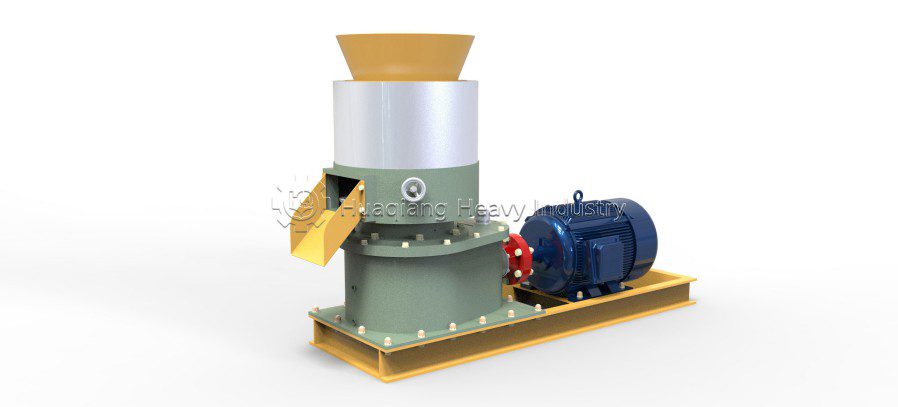
Flat Die Pelleting Machine
A flat die pellet mill is a dry pelletizing device based on the principle of die roller extrusion molding. According to the movement state of the actuators, it can be divided into three types: moving roller type, moving-mode type, and double-moving die roller type. According to the shape of the grinding roller, it can be divided into two types: conical roller type and straight roller type. Moving roller type is common in larger models, while moving-mode and double-moving die roller types are common in small flat die pellet mills. This equipment uses a two-stage transmission of belt and worm gear, resulting in smooth rotation and low noise. The equipment has high productivity, a compact structure, low operating costs, and is easy to operate. It also has high structural strength and is suitable for molding various raw materials with different properties, such as biomass fuel, fertilizer, feed, and plastics.
System composition and technical architecture
The technical architecture of flat die pellet mills can be divided into two main types:
Type 1: Moving Roller Flat Die Pellet Mill – The flat die is stationary, and the pressure roller performs planetary motion on the flat die. Larger models generally use this type. Its advantage is that the pressure roller can be made larger and has a stronger pressure-bearing capacity.
Type 2: Moving Die/Die Roller Dual-Action Flat Die Pellet Mill – The flat die rotates or the flat die and pressure roller move simultaneously. Commonly found in small flat die pellet mills.
Based on pressure roller shape:
Conical Roller Type – The pressure roller is conical, with both ends having the same linear velocity as the inner and outer rings of the die plate. This eliminates misalignment friction between the roller and the die, reducing resistance and energy loss.
Straight Roller Type – The pressure roller is straight, with a relatively simple structure.
Industry applications and process compatibility
Flat die pellet mills are suitable for various industries. Organic fertilizer industry: They can produce organic fertilizer, bio-organic fertilizer, and organic-inorganic compound fertilizer pellets. Feed industry: They can produce feed and forage pellets. Biomass energy industry: They can produce biomass fuel pellets from sawdust, straw, etc. Waste treatment industry: They can process waste pellets from rubber and plastics. This versatile machine is adaptable to a wide range of raw materials.

Material adaptability analysis
Flat die pellet mills are highly adaptable to various raw materials. They have low moisture requirements: They can handle raw materials with low moisture content (20%-40%) and fine grinding requirements. They are also highly adaptable to different fibers: suitable for pelleting coarse fibers such as sawdust, rice husks, cotton stalks, cottonseed hulls, weeds, and various crop straws. They have low viscosity requirements: capable of processing materials with low adhesion and difficult to form. They also have moderate particle size requirements: raw materials need to be ground to 2-5mm.
Core principles and forming mechanism
The working principle of a flat die pellet mill is based on die roller extrusion molding. An electric motor drives the main shaft via a gearbox, which in turn drives the pressure rollers in a circular motion on a stationary flat die. Under the influence of gravity and a distribution device, the material is evenly spread on the die. The rotating pressure rollers continuously roll over the material layer, forcibly squeezing the material into the die holes. After undergoing compression, shaping, and molding processes within the die holes, the material is extruded and cut into pellets by a cutter.
The unique feature of the flat die pellet mill is its “conical wheel flat die” structure. The pressure rollers are conical in design, ensuring that both ends maintain the same linear velocity as the inner and outer rings of the die plate. This prevents misalignment and friction between the rollers and the die, reducing resistance, minimizing energy loss, and extending the die’s lifespan. A screw-based center pressure adjustment mechanism allows the die gap to be adjusted according to the material characteristics.

Comparative analysis with ring die pellet mill
Flat die pellet mills and ring die pellet mills differ in several aspects:
Speed: Ring die pellet mills operate at high speeds, resulting in a high breakage rate upon material discharge; flat die pellet mills operate at low speeds, resulting in a low breakage rate.
Pressure roller adjustment: Ring die pellet mills use two screws on the eccentric wheel in the center of the pressure roller to adjust the pressure; flat die pellet mills use a threaded column center adjustment mechanism, providing a force of up to 100 tons, resulting in smooth descent, gentle impact, and uniform pressure.
Feeding method: Flat die pellet mills use vertical feeding, allowing material to be fed directly into the pelleting chamber without additional assist devices; ring die pellet mills use side-feeding, making it difficult for lighter materials to enter the pelleting chamber.
Heat dissipation: Vertical feeding in flat die pellet mills facilitates heat dissipation; ring die pelleting chambers do not dissipate heat effectively, limiting the lifespan of the transmission system.
Investment cost: Flat die pellet mills have a relatively simple and compact structure, resulting in lower investment costs and typically lower energy consumption than ring die pellet mills with the same capacity. Flat die pellet mills are more suitable for pelleting coarse feed.
Selection criteria and procurement recommendations
When selecting a flat die pellet mill, the following key points should be considered:
1. Capacity:Choose the appropriate model based on daily processing capacity. For small-scale processing, choose PM400 or lower; for medium-to-small-scale production, choose PM600; for large-scale continuous production, choose PM800 or PM1000.
2. Raw Material Selection:Select the appropriate technology based on the type of raw material. For coarse fibrous materials, prioritize conical roller flat die pellet mills; for high-moisture materials, choose models with low moisture requirements.
3. Quality Selection:Prioritize models with a robust cast structure, heavy-duty thrust bearings, and a forced cooling and lubrication system.
4. Service Selection:Prioritize manufacturers with comprehensive after-sales service to ensure you receive installation guidance, operation training, and timely maintenance support.
Models and parameters of flat die pellet mills
| Organic Fertilizer Flat-die Pellet Machine | ||||
| Model | KP-210 | KP-260 | KP-400 | KP-500 |
| Capacity (t/h) | 0.2-0.3 | 0.4-0.5 | 1-1.2 | 2-5 |
| Pelleting Rate (%) | >95% | >95% | >95% | >95% |
| Rotation Speed(r/min) | 370 | 260 | 260 | 125 |
| Power(Kw) | 7.5 | 11 | 30 | 55 |