
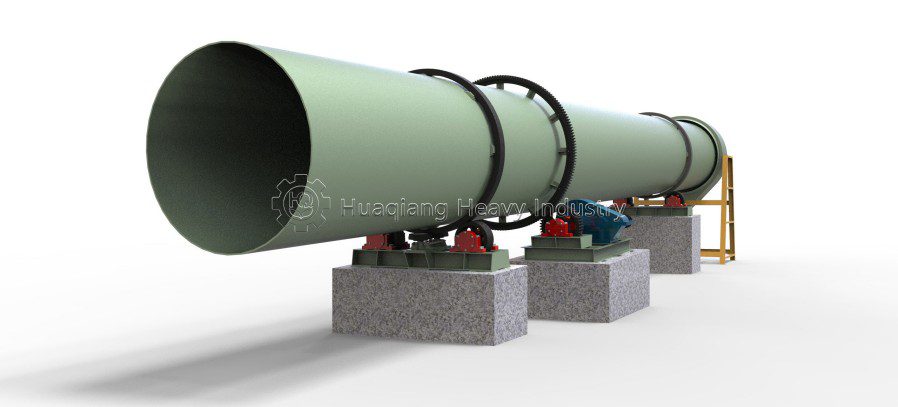
Drum Fertilizer Cooler

Our Services

Have a
project in
mind?

Drum Fertilizer Cooler

The rotary drum cooler is a cooling device that utilizes a horizontal rotating drum as its main body to rapidly lower the temperature of granular materials through a combination of mechanical tumbling and forced air cooling. Structurally, it bears a strong resemblance to the rotary drum dryer—sharing components such as the drum shell, gears, riding rings, and support rollers—yet their functions differ fundamentally: the dryer utilizes a hot air input, whereas the cooler employs a cold air input.
The core competitive advantage of the rotary drum cooler lies in its dual cooling mechanism: mechanical tumbling combined with forced air cooling. Through the synergistic action of the rotating drum and internal lifting flights, materials are continuously tumbled and dispersed to form a uniform curtain of material; simultaneously, an induced draft fan forces cold air through this curtain, facilitating highly efficient heat exchange. This dual mechanism significantly accelerates the cooling process, effectively resolving industry-wide challenges associated with traditional natural cooling methods, such as slow cooling rates, large footprint requirements, and uneven cooling.

System Composition and Technical Architecture

The technical architecture of the rotary cooler consists primarily of the following components:
(I) Drum and Support Assembly: Includes the rotating drum, riding rings (tires), support rollers, thrust rollers, etc. The drum is a rotating cylinder; riding rings at both the feed and discharge ends rest upon the support roller assemblies.
(II) Drive Assembly: Includes the electric motor, gearbox, pinion gear, large girth gear, etc. The drum is rotated via a large girth gear fixed to the drum body, driven by the transmission system.
(III) Material Lifting Assembly: Includes lifting flights (lifters) installed on the inner wall of the drum. These flights continuously lift and drop the material; various configurations—such as 90°, 45°, or 135° bent plates—may be employed.
(IV) Ventilation Assembly: Includes the induced draft fan (exhaust fan), air inlet, gas discharge hood, air ducts, etc.
(V) Sealing Assembly: Includes sealing devices at both the feed and discharge ends.

Cooling Principles and Heat Exchange Mechanisms

The cooling principle of the rotary drum cooler is based on the core heat transfer mechanism of “forced convection heat exchange.”
Heat exchange method: Heat exchange occurs through direct contact between the material and cold air. Heat is transferred from the surface of the hot granules to the surrounding cold air. Driven by an induced draft fan, the cold air flows continuously, carrying the heat away.
Counter-current cooling: A counter-current cooling method is employed. Cold air enters from the discharge end and flows toward the feed end, while the material moves from the feed end toward the discharge end; thus, the airflow and material movement are in opposite directions. This counter-current arrangement maintains the maximum temperature gradient between the cold air and the material, resulting in higher cooling efficiency.
Factors affecting cooling efficiency: Contact area between material and cold air (determined by the dispersion effect of the lifting flights); cold air flow rate and velocity (determined by fan performance); material residence time inside the drum (determined by drum length, inclination, and rotational speed); temperature difference between the feed material and the cold air; and the design and arrangement of the lifting flights.

Airflow Control and System Negative Pressure

Airflow control is a critical parameter affecting cooling efficiency.
Airflow matching: The cooling air flow rate must be matched to the material processing rate. Insufficient airflow leads to inadequate cooling, while excessive airflow increases energy consumption and dust emissions.
Negative pressure operation: An induced draft fan creates negative pressure within the system, preventing dust from escaping through seals.
Fan maintenance: Regularly clean accumulated dust from the fan impeller; a drop in fan efficiency directly impacts cooling performance.

Comparison with the structure of the dryer

Rotary coolers and rotary dryers share a highly similar structural design.
Similarities: Both consist of components such as a cylindrical shell, large and small gears, riding rings, and thrust/support rollers. Both utilize a structure featuring an inclined, rotating cylindrical shell. Both rely on the rotation of the shell and internal lifting flights to agitate the material.
Differences: Dryers utilize a high-temperature hot air input, whereas coolers utilize a low-temperature cold air input. Dryers require a hot-blast stove, while coolers only need an induced draft fan to draw in ambient air. Dryers must account for the effects of high temperatures on the shell, whereas coolers operate in an ambient temperature environment.