
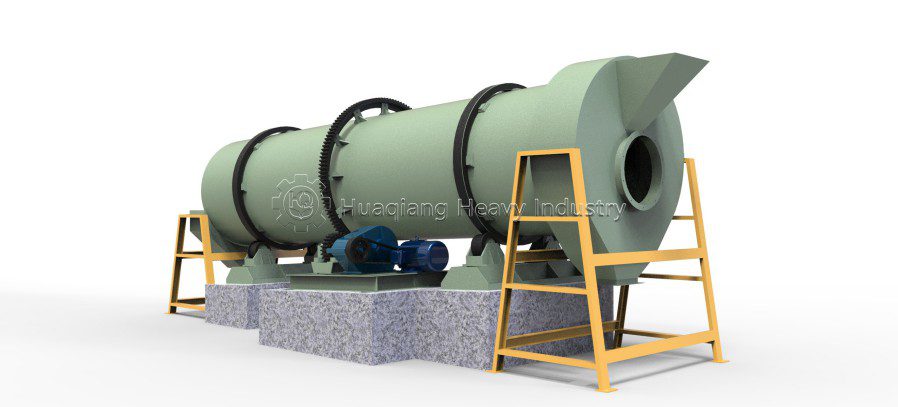
The coating machine is a core piece of equipment in the post-processing stage of the fertilizer industry chain, enabling functional product upgrades and the enhancement of commercial value. By applying a functional coating layer to the surface of granular fertilizers—using either powder dusting or liquid coating processes—the machine imparts value-added properties such as anti-caking capabilities, slow or controlled nutrient release, and improved aesthetics. It serves as a key technological tool for transforming fertilizers from “basic products” into “high-value-added products.”
Utilizing a specialized spraying process that combines liquid and solid powder materials, the coating machine creates a protective film on the surface of compound fertilizer granules. This film isolates the granules from the surrounding air, effectively preventing caking while enhancing surface luster. In the production of slow- and controlled-release fertilizers, the machine creates a functional coating layer on the granules to achieve precise nutrient release control. Offering significant value addition at a relatively low investment and operating cost, the coating machine is an ideal choice for fertilizer manufacturers looking to improve product quality and expand their market reach.
The hardware components of the coating machine primarily include:
(I) Main Unit Assembly: Consists of a rotating drum and internal lifting flights; it serves as the core vessel for the coating operation. The drum is fabricated by welding medium-carbon steel plates and is lined with polypropylene or acid-resistant stainless steel.
(II) Drive Assembly: Includes the main motor, speed reducer, pulleys, V-belts, drive shaft, split gear, and large ring gear. The motor drives the pulleys, V-belts, and speed reducer to transmit power to the drive shaft; the machine body is then operated through the meshing of the split gear with the large ring gear.
(III) Support Assembly: Includes support frames, support rollers, and riding rings (tires). The support frames are fabricated by welding medium-carbon steel plates and channel steel. The riding rings are fixed to both sides of the machine body to support the entire unit.
(IV) Auxiliary Systems: Include screw conveyors, mixing tanks, oil pumps, spraying systems, screens, heating jackets, and discharge ports. Some models are equipped with high-pressure air supply pipes and hot air ducts to assist the process.
Coating machines serve a wide range of applications and user groups:
Compound fertilizer manufacturers: Use coating machines to apply anti-caking treatments to granules, thereby enhancing product storage stability and visual appeal.
Slow- and controlled-release fertilizer manufacturers: Use coating machines to apply polymer or sulfur coatings for controlled-release functionality.
Organic fertilizer manufacturers: Use coating machines to prevent caking and improve the appearance of organic fertilizer granules.
Bio-organic fertilizer manufacturers: Use coating machines to apply coatings containing microbial agents, preserving the viability of the microorganisms.
Large-scale fertilizer production facilities: Coating machines are standard equipment for production lines with annual capacities ranging from 10,000 to 200,000 tons.
The coating machine represents the final step in the post-processing section of the entire fertilizer production line. The complete post-processing workflow consists of: granulation, drying, cooling, screening, coating, and packaging. The coating machine is connected in sequence with upstream and downstream equipment via belt conveyors and bucket elevators to form a continuous production line, enabling uninterrupted manufacturing. It is used to apply performance-enhancing, slow-release materials to the surface of granular fertilizer. Following the coating process, the granules pass through a buffer hopper to link with the packaging line, ensuring efficient, continuous operation.
Value Enhancement through Quality Improvement: Coating machines significantly upgrade the commercial quality of fertilizer granules by applying a functional coating layer to their surfaces. Coated granules feature smooth surfaces, uniform color, and excellent flowability. Anti-caking coatings effectively resolve issues related to clumping during storage and transport, while slow-release coatings substantially boost nutrient utilization efficiency.
Value-Added Functionality: Coating machines transform standard fertilizers into multifunctional products that integrate anti-caking properties, slow/controlled release capabilities, and biological enhancement. Internal structures can be specially designed to meet process requirements, and trace elements can be incorporated during the coating process to further improve fertilizer efficacy. The price premium commanded by coated products far outweighs the investment and operating costs of the coating equipment.
Environmental Value: Slow- and controlled-release fertilizers minimize nutrient loss and volatilization through the precise regulation of nutrient release. This reduces the risk of agricultural non-point source pollution, improves fertilizer utilization efficiency, and lowers the overall volume of chemical fertilizer application.