
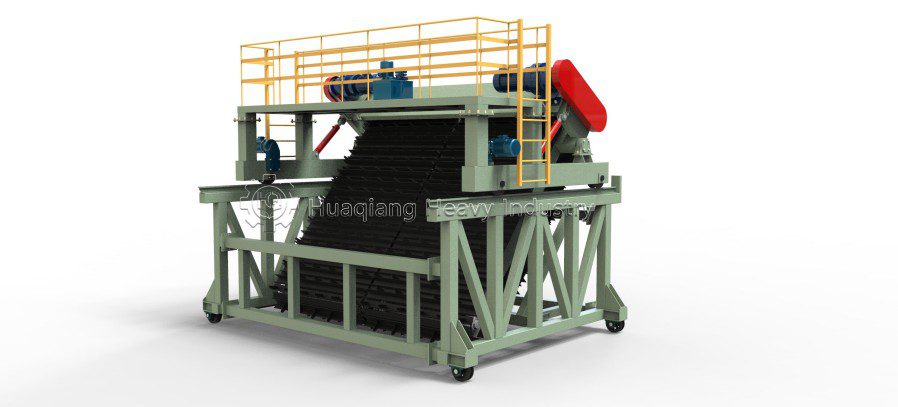
Chain compost turner
The chain compost turner is a large-scale aerobic fermentation turning equipment with chain drive as its core technology. Building upon the design of traditional trough-type turners, this equipment incorporates multiple sets of linked chain plates to integrate the processes of turning, crushing, mixing, oxygenating, and machine displacement. The core competitiveness of the chain compost turner lies in “chain plate drive + deep turning” – the equipment is equipped with multiple sets of linked chain plates, and the turning width can reach 3-6 meters and the depth 1.5-2.2 meters.
Compared with traditional rake-tooth compost turners, chain-type compost turners turn the compost more thoroughly and without dead corners, achieving a material mixing uniformity of over 90%. Compared with wheel-type compost turners, chain-plate compost turners have greater advantages in deep trench operations, with lower turning resistance and lower energy consumption. For large and medium-sized fertilizer plants that seek short fermentation cycles, high composting levels, and large processing capacities, investing in a stable chain compost turner is an ideal choice for building a standardized organic fertilizer production line.
System Composition and Technical Architecture
The technical architecture of the chain-type compost turner can be categorized into the following layers:
(I) Mechanical Execution Layer: Composed of multiple sets of linked chain plates, turning paddles, and high-strength, wear-resistant tines (curved blade tines). The turning paddles are equipped with 390 replaceable, wear-resistant curved tines. The chain plates are made of 65Mn alloy steel.
(II) Power Transmission Layer: Composed of a motor, a gearbox, chains, and sprockets. The transmission system utilizes a hardened-gear-surface gearbox, a chain drive mechanism, and a paddle structure supported by rolling elements.
(III) Travel and Displacement Layer: Composed of a longitudinal travel mechanism and a transverse displacement mechanism. It is equipped with a transfer carriage for lane switching, enabling multi-lane operations.
(IV) Hydraulic Adjustment Layer: Composed of a hydraulic lifting system. The lifting and lowering of the turning components are controlled by the hydraulic system.
(V) Intelligent Control Layer: Composed of a control cabinet and a remote control unit.
Industry Applications and Process Compatibility
Chain-type compost turners are suitable for large-scale aerobic composting processes.
Organic fertilizer industry: Processing organic waste such as livestock and poultry manure.
Environmental protection industry: Aerobic composting of municipal sludge and solid waste.
Agriculture industry: Processing crop straw, garden waste, and similar materials.
Industrial sector: Processing industrial organic waste such as distillers’ grains, medicinal residues, and biogas digestate.
Material Suitability Analysis
The chain-type compost turner demonstrates exceptional adaptability to various materials. High-moisture materials: capable of processing materials with high water content. High-viscosity materials: reduces material adhesion by 80%. Large, clumped materials: features strong crushing capabilities and ensures effective oxygenation of the compost pile. Fibrous materials: the chain plates can powerfully cut through long fibers.
Key Selection Criteria and Procurement Recommendations
When selecting a chain-type compost turner, focus on the following key factors:
1. Fermentation channel width: Choose the appropriate model based on the channel width (ranging from 2 to 12 meters). Select a lightweight model for widths of 2–4 meters, a medium-duty model for 4–9 meters, and a heavy-duty model for widths exceeding 9 meters.
2. Processing scale: Determine equipment specifications based on daily processing volume, ensuring a capacity margin of 10%–20%.
3. Material characteristics: For high-moisture, sticky materials, prioritize models equipped with a crushing function and anti-tangling chain plates.
4. Chain plate material: Prioritize 65Mn alloy steel and pay attention to the wear-resistant surface treatment process.
5. After-sales service: Select a manufacturer that offers comprehensive after-sales support.
