
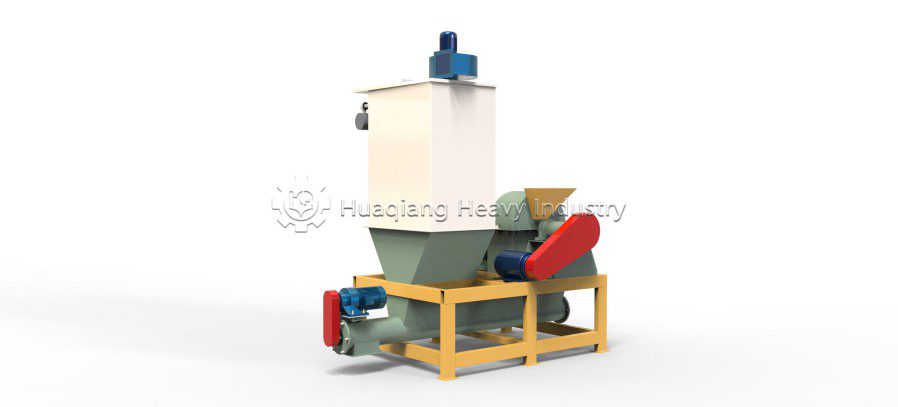
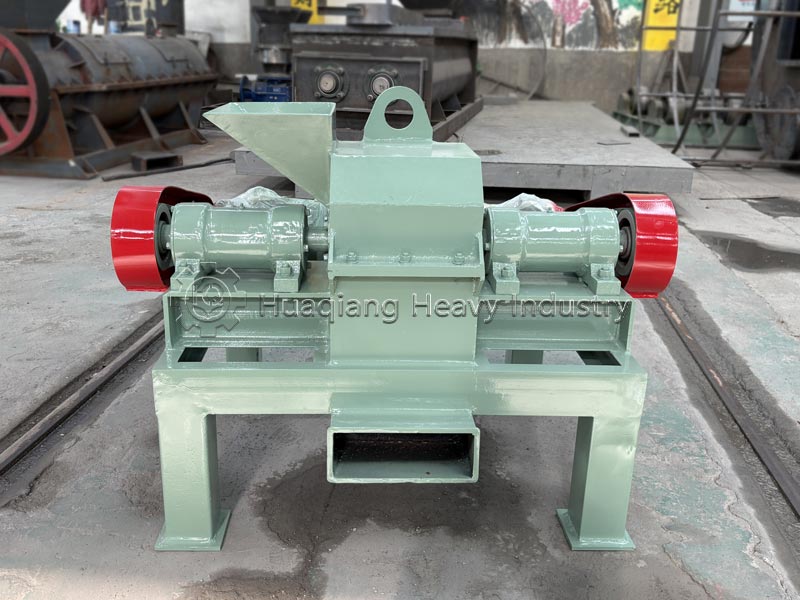
The cage crusher is a pulverizing machine that utilizes high-speed, counter-rotating dual cages to achieve impact-based size reduction. Designed based on the principle of impact crushing, the machine features inner and outer sets of cage bars rotating rapidly in opposite directions; material is pulverized as it moves from the inside out, striking the bars along the way. Classified as a medium-sized horizontal cage crusher, these machines come in two types based on rotor configuration: dual-rotor and single-rotor models.
The core competitive advantage of the cage crusher in the fertilizer industry lies in its dual-action pulverization mechanism—combining high-speed cage-bar impact with self-impact (particle-on-particle collision). Material is subjected to repeated impacts from the rapidly rotating bars while simultaneously colliding with other particles at high speeds driven by centrifugal force. This unique pulverization principle gives the cage crusher an irreplaceable advantage when processing caked fertilizers or high-moisture organic materials. In dual-rotor models, the two cages operate independently but share the same axis, with separate motors driving them to rotate in opposite directions. Single-rotor models feature one rotating cage and one stationary cage; while more compact in size, they offer lower production capacity.
The technical architecture of the cage mill can be categorized into the following levels:
(I) Dual-cage crushing assembly: Composed of an outer cage assembly and an inner cage assembly. Each cage consists of steel discs fixed to a hub and two or three concentric rings of steel rods rigidly mounted onto the discs. The steel rods are arranged in concentric circles perpendicular to the discs, with the rods of adjacent rings interleaved.
(II) Power transmission assembly: Composed of two electric motors, pulleys, and V-belts. These drive the inner and outer cages to rotate at high speeds in opposite directions.
(III) Feed and discharge assembly: Includes the feed inlet and the discharge outlet.
(IV) Adjustment and maintenance assembly: Includes a screw-based adjustment mechanism that facilitates the installation and removal of the cage assemblies.
Cage crushers are suitable for a wide range of industries. In the compound fertilizer industry, they crush caked raw materials such as urea, ammonium phosphate, and potash. In the organic fertilizer industry, they process semi-moist organic materials—such as fermented livestock manure and crop straw—after decomposition. In the chemical industry, they crush raw materials like kaolin, pottery clay, and bentonite. In the construction materials and mining sectors, they are used to crush limestone, dolomite, shale, coal gangue, and similar materials.
The cage crusher demonstrates strong adaptability to various materials. Moisture content: It accepts feed material with a moisture content of up to 40%; standard semi-wet fermented materials can be fed directly into the machine for crushing. Material hardness: It is particularly effective for harder materials and excels at crushing hard granular substances such as monoammonium phosphate (MAP), diammonium phosphate (DAP), and urea. Feed particle size: The average feed particle size is generally between 60 mm and 200 mm. Material type: It is suitable for crushing materials of lower hardness but is not appropriate for crushing extremely hard materials.
When selecting a cage crusher, focus on the following key points:
1. Rotor type: Choose based on production scale. Opt for a single-rotor model for small-to-medium operations, and a dual-rotor model for large-scale, continuous production.
2. Processing capacity: Select the appropriate model based on daily throughput. Choose the WLF650 model for an hourly output of 4–6 tons, or the WLF800 model for 6–10 tons per hour.
3. Material characteristics: Cage crushers are ideal for high-moisture materials (up to 40% moisture content) and are particularly well-suited for hard materials such as urea and ammonium phosphate.
4. Dust control configuration: Prioritize dust-free models equipped with cyclone dust collection systems.
5. Steel rod material: Pay attention to the material composition and wear resistance of the steel rods. Rods with an elliptical cross-section are preferable to accommodate uneven wear.
6. After-sales service: Choose a manufacturer with comprehensive after-sales support to ensure access to installation guidance, operational training, and timely maintenance services.