
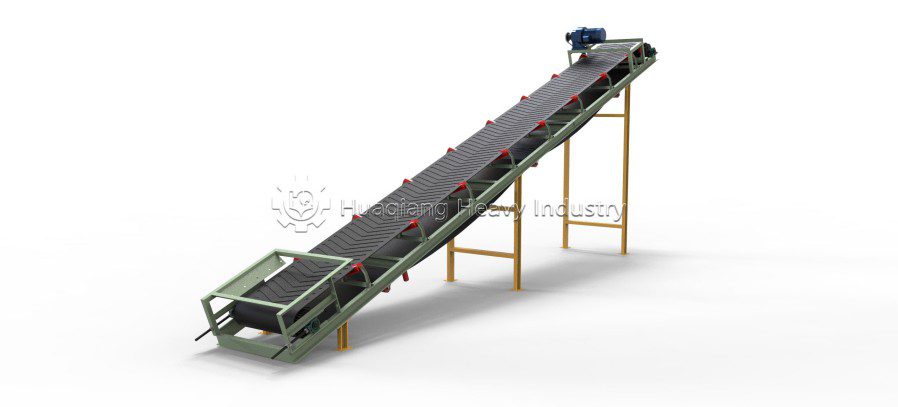
Belt Conveyor

Our Services

Have a
project in
mind?

Belt Conveyor

A belt conveyor is a type of transport machinery that utilizes a conveyor belt as both the traction and load-bearing element, relying on friction drive to facilitate continuous material transport. As one of the fundamental pieces of material handling equipment in industrial production, it is suitable for conveying a wide range of bulk materials and unit loads. Selecting the appropriate belt conveyor requires a comprehensive assessment of factors such as material characteristics, conveying distance, throughput capacity, and the operating environment; proper selection is crucial for ensuring long-term, stable equipment operation and minimizing operating costs.
The conveying capacity, range, and versatility of belt conveyors make them the preferred choice for linking various stages of the production process. Depending on the specific application, belt conveyors are categorized into two main types: stationary and mobile. Stationary belt conveyors are installed on fixed foundations and are designed for long-term, permanent conveying routes. Mobile belt conveyors are equipped with wheels at the base, allowing them to be repositioned freely according to operational needs. Scientific and rational equipment selection enables operation under the most economical conditions, thereby maximizing the return on investment.

Structural composition of the equipment

Belt conveyors are primarily composed of the following components:
(I) Conveyor belt: Serves as both the load-bearing and traction element. Depending on the material being conveyed and the transport distance, various types may be selected, such as cotton canvas, nylon, or EP (polyester) belts. Selection depends on factors such as material abrasiveness, temperature, and oil resistance.
(II) Drive unit: Includes the electric motor, gear reducer, drive pulley, etc. The drive pulley connects to the drive unit; its outer surface may be bare metal or covered with a rubber layer to increase the coefficient of friction.
(III) Idlers: Components that support the conveyor belt and the material. Types include troughing idlers (load-bearing section), flat/parallel idlers (return section), self-aligning idlers (for belt tracking/correction), and impact idlers (at loading points).
(IV) Pulleys: Includes drive pulleys and bend/return pulleys.
(V) Tensioning device: Types include screw, carriage, counterweight, and hydraulic systems.
(VI) Frame: Supports all components.
(VII) Auxiliary devices: Includes belt cleaners, discharge devices, and safety protection devices such as belt sway (misalignment) switches, speed switches, and pull-cord switches.

Application scope of the equipment

Belt conveyors are widely used across various industries requiring continuous material transport. Mining and metallurgy: transport of ore, ore fines, and concentrates. Coal and power: transport of raw coal, gangue, and fly ash. Building materials and cement: transport of limestone, cement, and sand/gravel aggregates. Chemicals and fertilizers: transport of raw materials, finished products, and powdered chemical products. Ports and terminals: loading, unloading, and transshipment of bulk cargo. Grain and agriculture: transport of grain and animal feed. Organic and compound fertilizer production: continuous transport of materials between processing stages.

Types of usable raw materials

Belt conveyors can transport a wide variety of materials. These include bulk materials such as coal, crushed stone, sand, cement, chemical fertilizers, grain, cereals, ore, and fly ash, as well as packaged goods (such as bagged materials) weighing less than 100 kg per unit. Generally, the temperature of the conveyed material should be below 60°C.

The working principle of the equipment

The working principle of a belt conveyor is as follows: the conveyor belt loops around the drive pulley and various redirection pulleys to form a closed circuit, with appropriate tension applied by a tensioning device. During operation, the drive unit provides power, which is transmitted to the belt via friction between the drive pulley and the belt itself, driving the belt in continuous motion. Material is loaded onto the belt at the feed end and transported to the discharge end for unloading. The equipment must be started under no-load conditions; material should only be fed in once normal operation has been established.

Equipment operating instructions

(I) Pre-start Checks: Before startup, adjust the conveyor belt tension and ensure belt fasteners are secure; verify that drive components—such as bearings, gears, and chains—are in good condition; ensure all idlers and safety guards are in place; and confirm that electrical grounding or neutral protection is effective. Check the area around the conveyor for foreign objects. Stationary belt conveyors must be installed on a solid foundation.
(II) No-load Startup: The belt conveyor must be started without a load; material feeding should only begin after normal operation is established. Starting the machine with a load already on the belt is prohibited. If the machine is difficult to start or the load increases unexpectedly, stop the machine immediately; forced startup is not permitted.
(III) Operational Monitoring: Ensure uniform material feeding during operation to avoid overloading. Monitor the conveyor belt for smooth movement and check for any belt misalignment. When multiple conveyors are used in a series (transferring material from one to another), the shutdown sequence must proceed sequentially from the discharge end back to the feed end (from rear to front).
(IV) Shutdown Procedure: Clear all material from the conveyor before stopping; the machine should only be shut down after the belt has been completely emptied of material. Overload or overspeed operation is prohibited.

Equipment maintenance methods

Daily Maintenance: Clean residual material and dust from the equipment after each shift. Inspect the conveyor belt for damage and check joints for looseness. Check the lubrication status of roller bearings and replenish grease promptly.
Periodic Maintenance: Regularly tighten bolts and nuts to prevent loosening due to vibration. Periodically check the conveyor belt alignment to ensure smooth operation. Regularly inspect idlers and other components, replacing any that are damaged.
Lubrication Management: Add lubricant promptly to ensure proper bearing lubrication. Change the gear oil in the speed reducer according to the prescribed schedule.