
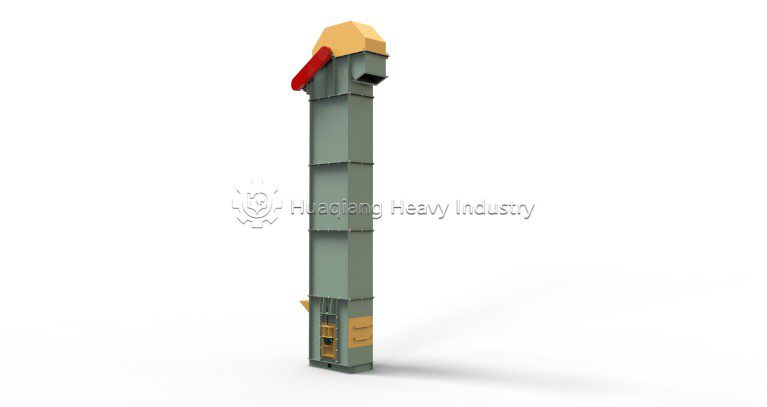
A bucket elevator is a machine designed for the continuous vertical transport of bulk materials using buckets rigidly attached to a traction element. This equipment is widely used across industries such as food processing, healthcare, chemicals, and mining. During prolonged operation, the equipment inevitably encounters various malfunctions due to factors such as environmental conditions, operational practices, and wear and tear. Timely and accurate diagnosis of the causes of these faults, followed by the application of correct troubleshooting measures, is crucial for ensuring the equipment’s normal operation and minimizing downtime.
The bucket elevator primarily consists of traction elements (rubber belts or chains), buckets, a drive unit, head and tail pulleys (or sprockets), a tensioning device, and the casing. The complete machine comprises an upper housing, a drive unit, intermediate casing sections, an inspection door, an inlet, and an outlet.
Bucket elevators are widely used in the production of compound, organic, bio-, and controlled-release fertilizers, as well as in industries such as mining, metallurgy, coal, electric power, port operations, chemicals, building materials, and grain handling.
Bucket elevators are suitable for conveying powdery, granular, and small-lump materials that are non-abrasive or mildly abrasive, such as fertilizers, grain, cereals, coal, cement, crushed stone, sand, clay, and ore.
The working principle of the bucket elevator is as follows: buckets scoop up material or receive it from a bottom storage zone and are lifted to the top by a traction mechanism; after passing over the head pulley, the material is discharged into a receiving chute via centrifugal force, gravity, or a combination of both. The entire process takes place within an enclosed casing.
(I) Pre-start preparations: Before operation, thoroughly inspect all fastening bolts for looseness. Check the interior of the bucket elevator for foreign objects, material buildup, or accumulated water. Verify that the lubrication for all components meets requirements and confirm that the anti-reverse device is in good working order.
(II) Startup sequence: Start the discharge equipment first, then the bucket elevator. The elevator must be started without a load. Strictly adhere to the principle of “start without load, stop without load.”
(III) Operational monitoring: Ensure uniform material feeding during operation to avoid overloading. Monitor the elevator for any swaying or impact. Do not open the head casing or slide out the base access panel while the machine is running normally.
(IV) Shutdown procedure: Stop the material feed first. Press the stop button only after all material has flowed out. The elevator must be completely emptied of material before the machine is shut down.
(I) Daily Inspection: Check for deformation or wear on the chains and buckets; verify proper chain tension; check for material blockages at the inlet and bottom; inspect for loose or detached fasteners; and listen for abnormal noise from the gear reducer.
(II) Periodic Maintenance: Tighten all loose bolts; check the quality and level of the lubricating oil; inspect transmission components for wear; and change the lubricating oil at scheduled intervals.